
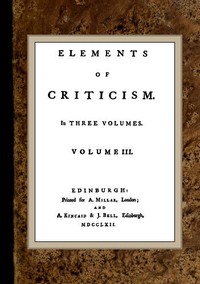
Elements of Criticism, Volume III. by Lord Henry Home Kames
Let's be clear: this isn't a novel. There's no plot in the traditional sense. Think of it as a detective story for art and emotion. Lord Kames, a real-life Scottish judge, acts as our investigator. His case? To uncover the fundamental principles behind human taste and criticism. The 'story' is his journey through different forms of art—poetry, painting, architecture, even gardening—to find the common rules they all follow.
The Story
Kames starts with a simple idea: our feelings and perceptions aren't random. He believes there are laws, just like in physics, that govern how we react to art and beauty. Volume III gets into the nitty-gritty. He examines how emotions like pity and fear work in a tragedy, why certain patterns in a poem are pleasing, and how our senses connect to our feelings. He uses tons of examples, often from Shakespeare and classical writers, to prove his points. The 'conflict' is between chaotic personal taste and his search for a solid, shared foundation for criticism. Can he find it?
Why You Should Read It
You might think a 250-year-old book on criticism would be dry, but Kames is shockingly readable. He writes like a curious friend explaining a fascinating puzzle. His goal wasn't to show off; it was to be useful. Reading it today is a trip. You see the birth of ideas we now take for granted about storytelling and psychology. When he talks about suspense or why we connect with fictional characters, you'll nod along. It makes you realize people have been overthinking their favorite stories for centuries! It's less about agreeing with every rule he sets and more about enjoying the process of his thinking.
Final Verdict
This is not for everyone. If you want a fast-paced page-turner, look elsewhere. But if you're a naturally curious person who loves art, stories, or psychology, it's a hidden gem. It's perfect for writers wanting to understand the mechanics of emotion, history buffs interested in 18th-century thought, or anyone who's ever had a heated debate about a 'good' vs. 'bad' movie. It's a slow, thoughtful conversation with a brilliant mind from the past. Dip in and out of chapters that interest you. You'll come away seeing the world—and every story in it—a little differently.
No rights are reserved for this publication. Share knowledge freely with the world.
Patricia Davis
9 months agoUnlike many other resources I've purchased before, the historical context mentioned in the early chapters is quite enlightening. A refreshing and intellectually stimulating read.
Nancy Young
1 year agoHaving read this twice, the storytelling feels authentic and emotionally grounded. Thanks for sharing this review.
Robert Miller
9 months agoThe index links actually work, which is rare!
Joseph Hill
1 year agoAfter hearing about this author multiple times, it creates a vivid world that you simply do not want to leave. A true masterpiece.


John Anderson
6 months agoAfter a thorough walkthrough of the table of contents, the attention to detail regarding the core terminology is flawless. The price-to-value ratio here is simply unbeatable.