
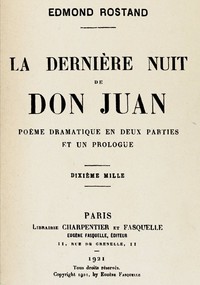
La dernière nuit de Don Juan: poème dramatique en deux parties et un prologue
Edmond Rostand is best known for the swashbuckling romance of Cyrano de Bergerac, but here he gives us something darker and more philosophical. La dernière nuit de Don Juan (The Last Night of Don Juan) is a dramatic poem that flips the famous legend on its head.
The Story
The play opens with a prologue in Hell, where a bored Don Juan has struck a deal with the demonic Statue of the Commander. In exchange for his soul, he gets to return to Earth for one final night. His mission? To seduce Doña Juana, a woman known for her purity and faith, and add her name to his infamous ledger. If he succeeds, he wins a reprieve. If he fails, it's damnation at dawn. What follows is a frantic, poetic race against time as the aging libertine employs every trick in his book. But this isn't the young, irresistible Don Juan. He's a performer running out of material, facing a woman whose genuine virtue exposes the hollow core of his lifelong performance.
Why You Should Read It
This isn't just another retelling. Rostand uses the familiar character to ask big questions about identity, performance, and what we leave behind. The Don Juan here is pathetic, funny, and tragically self-aware all at once. You almost feel for him as his old lines fall flat and he realizes his entire life has been a kind of script. The dialogue is sharp and lyrical, full of the wit Rostand is famous for, but it cuts deeper. It's about the moment a charmer's charm fails, and he has to look in the mirror. The tension isn't really about seduction; it's about whether a man can change when he's built his whole life on not changing.
Final Verdict
Perfect for readers who love classic stories turned inside out, and for anyone who enjoys witty, talky plays that pack a philosophical punch. If you liked the verbal duels and tragic romance of Cyrano, you'll appreciate Rostand's clever language here, even if the mood is more somber. It's a short, powerful read for a thoughtful evening—a brilliant character study of a myth facing his final curtain call.
The copyright for this book has expired, making it public property. It serves as a testament to our shared literary heritage.
Ashley Harris
2 years agoI've gone through the entire material twice now, and the way the author breaks down the core concepts is remarkably clear. I appreciate the effort that went into this curation.
David Moore
11 months agoIf you're tired of surface-level information, it addresses the common misconceptions in a very professional manner. It’s hard to find this much value in a single source these days.
Emily Moore
1 year agoThe clarity of the introduction set high expectations, and the visual layout and supporting data make the reading experience very smooth. A refreshing and intellectually stimulating read.
Nancy Hernandez
10 months agoAfter spending a few days with this digital edition, the transition between theoretical knowledge and practical application is seamless. This exceeded my expectations in almost every way.
Joseph Hernandez
7 months agoHaving read the author's previous works, the nuanced approach to the central theme was better than I expected. It definitely lives up to the reputation of the publisher.