
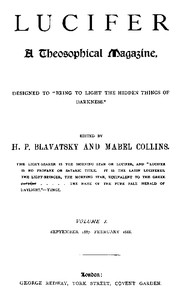
Lucifer: A Theosophical Magazine. Volume I. September 1887-February 1888.
Let's clear something up first: this isn't a novel. 'Lucifer: A Theosophical Magazine' is exactly what it says on the cover—a collection of essays, articles, and editorials published over six months in 1887-88 by the Theosophical Society. There's no single plot. Instead, think of it as a recorded conversation, or maybe a controlled intellectual explosion.
The Story
The 'story' is the mission. Edited by the formidable Helena Blavatsky and others, the magazine sets out to challenge the status quo. It argues that materialistic science and dogmatic religion have both failed humanity. Each issue is a mix of dense philosophical treatises, reports on psychic research, critiques of colonialism, analyses of ancient texts, and calls for social justice. One article might dissect Buddhist philosophy, while the next condemns the treatment of factory workers. The through-line is a search for a unifying spiritual truth behind all world religions and a belief in the limitless potential of the human mind.
Why You Should Read It
I love this book for its sheer audacity. The writers weren't tiptoeing around; they were throwing open doors everyone else kept shut. Reading it, you feel their urgency and their frustration. Yes, some of the science is hilariously outdated, and the prose can be Victorian-heavy, but the core questions are timeless. They're asking about consciousness, our place in the cosmos, and how to build a better society—questions we're still wrestling with today. It's also a masterclass in seeing how radical ideas are born and packaged. You get Blavatsky's fiery, uncompromising voice right next to calmer, more analytical pieces. It's a messy, inspiring, and deeply human project.
Final Verdict
This is not a casual beach read. It's for the curious, the patient, and anyone interested in the history of ideas. Perfect for history buffs who want to go beyond dates and wars to the undercurrent of belief, for spiritual seekers tired of modern packaged answers, or for readers who just enjoy primary sources that haven't been sanitized. If you've ever wondered what people were really thinking outside the mainstream in the 1880s, this is your backstage pass. Approach it with an open mind and a dictionary, and you'll be rewarded with a truly unique glimpse into a forgotten intellectual revolution.
This masterpiece is free from copyright limitations. Distribute this work to help spread literacy.
Ashley Lopez
1 year agoRight from the opening paragraph, the author doesn't just scratch the surface but goes into meaningful detail. A refreshing and intellectually stimulating read.
James White
1 month agoHaving explored several resources on this, I find that the formatting on mobile devices is surprisingly crisp and clear. This exceeded my expectations in almost every way.
Margaret Gonzalez
6 months agoThis is an essential addition to any academic digital library.
Richard White
1 year agoThis digital copy caught my eye due to its reputation, the step-by-step breakdown of the methodology is extremely helpful for students. The price-to-value ratio here is simply unbeatable.






Barbara Anderson
1 year agoFinally found a version that is easy on the eyes.