
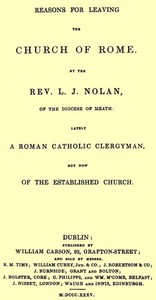
Reasons for Leaving the Church of Rome by Laurence J. Nolan
The Story
So, honestly, this book isn’t some dry history lesson. Nolan knocks on the doors of Chester’s town records and pulls out letters, court cases, and confessions from normal John and Jane Does of the 1500s. These documents told real people’s reasons for leaving the Roman Catholic Church during a time when doing so could literally get you executed. Think about it: in Tudor England, religion was tangled with civic life, power plays, and street-level grudges. Nolan just lets these speakers have the floor. A few lean on Bible verses, some complain about money and hating the local abbot, and others obsess over queenly authority. Yeah, it gets messy. But also interesting—like being a fly on the wall during a stranger's life-altering decision.
Why You Should Read It
Reading this, I kept thinking about that split between what large institutions shout from their pulpits and what churns beneath, in ordinary fears and furtive behaviors. For me, the most gripping part was the normalcy in these 500-year-old letters. People echoed neighbors, acted out of annoyance and survival. There were no angels or demons, just confused humanity clunking through chaos. One entry in Nolan’s collection voices real doubt, another exhibits peer pressure 1.0. Please don’t misunderstand this—it challenges my own black-and-white view of history as a grand ideological clashing swords. It draws readers way warmer instead. It almost feels like self-reflection wearing 1500s boots.
Final Verdict
Who should flip into page one of Nolan's microhistory? It whispers to real Christians wrestling with insider/outsider labels. Civil rights advocates locating silenced voices should check on it too—those records scream obedience in a supped-up system few felt inside. Still, scale your expectations downward if you love a hook-and-smoke mystery: it doesn't mashpad a personal story, but preserves hidden biographies in snapple-cut segments. I whiff entire trivia questions within parentheses of cultural defiance or adaptation. Plainly best for thinking reads who mark dates as story-seeds, this book fits between classic Bible commentaries and pop pastor tales. Expect talking-library atmosphere? Perfect for weekends beside coffee and paper slates big enough to jot your insights and eyebrows. Historical writers! Political junkie? Click, click. Everyone else? Borrow wonder instead of your local smartphone scrolling.”
This title is part of the public domain archive. Share knowledge freely with the world.
Mary Harris
1 year agoI wanted to compare this perspective with traditional views, the quality of the diagrams and illustrations (if applicable) is top-notch. I'm genuinely impressed by the quality of this digital edition.





Kimberly Brown
3 months agoI've been looking for a reliable source on this topic, and the language used is precise without being overly academic or confusing. A mandatory read for anyone in this industry.