
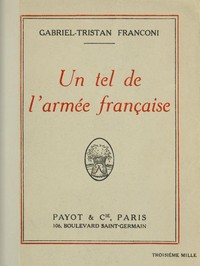
Un tel de l'armée française by Gabriel Tristan Franconi
Gabriel Tristan Franconi was a soldier himself, and he wrote this novel just before World War I. He died in 1918, which makes reading this feel like uncovering a hidden message in a bottle. It’s not a long book, but it packs a punch.
The Story
The plot follows a young French soldier, known only as 'Un tel' (a placeholder name meaning 'John Doe'). He’s assigned to a lonely fort in the Algerian desert, taking the place of a man who disappeared. His job is simple: keep watch. But nothing is simple here. The other soldiers are tense and closed-off. The Algerian landscape is vast and isolating. Whispers about the previous soldier’s fate hang in the air—did he desert? Was he killed? Or did something else, something the men are afraid to name, take him?
As Un tel investigates, he isn’t chasing a villain. He’s chasing a feeling—a deep sense of wrongness. The real conflict isn’t against a visible enemy, but against the creeping doubt and paranoia that the desert and the silence breed. The story builds this incredible tension not with battles, but with sideways glances, stifling heat, and the weight of things left unsaid.
Why You Should Read It
This book got under my skin. Franconi doesn’t give us a hero; he gives us an everyman caught in a machine he doesn’t understand. Un tel’s journey is about the erosion of certainty. You feel his loneliness and his growing fear that the truth might be worse than any lie. The real theme here is the cost of empire, not shouted from a podium, but felt in the grit and the quiet of a forgotten outpost. It’s about how systems of power can make ghosts of the men who serve them.
The prose is clear and direct, which makes the eerie atmosphere even more effective. You can almost feel the desert wind. It’s a masterclass in mood.
Final Verdict
This is a hidden gem. It’s perfect for readers who love historical fiction that focuses on psychology over action, or for anyone who enjoys a slow-burning, atmospheric mystery. If you liked the tense, existential dread of a book like The Tartar Steppe or the moral ambiguity of Conrad’s work, you’ll find a kindred spirit here. It’s a short, powerful read that stays with you long after you’ve turned the last page—a quiet, devastating look at a man lost in the machinery of duty.
Mason Nguyen
1 year agoI started reading out of curiosity and the content flows smoothly from one chapter to the next. I learned so much from this.
Linda Garcia
1 year agoEssential reading for students of this field.



Linda Garcia
1 year agoSimply put, the atmosphere created is totally immersive. Definitely a 5-star read.