About 259 minutes
Frank Merriwell's New Comedian; Or, The Rise of a Star — Inside the Classic
Exploration Survival Adventure Tales
59,412 recorded words. 7 minutes difference from this book's estimate.
View Gutenberg source #38610
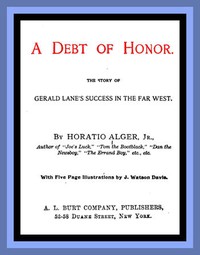
For A Debt of Honor: The Story of Gerald Lane's Success in the Far West — Key Ideas to Explore, the stored edition analysis reports 57,877 words, 4 hr 12 min estimated reading time, and 44 detected text sections.
The text analysis averages about 11.4 words per sentence, while the detected sections provide another way to judge how the source is divided.
Project Gutenberg metadata also associates the work with “Western stories,” connecting these edition facts with the source record’s subject description.
Explore this collection
These alternatives are selected using recorded categories and estimated reading time.
About 259 minutes
Exploration Survival Adventure Tales
59,412 recorded words. 7 minutes difference from this book's estimate.
View Gutenberg source #38610About 261 minutes
Exploration Survival Adventure Tales
59,906 recorded words. 9 minutes difference from this book's estimate.
View Gutenberg source #38222About 229 minutes
Exploration Survival Adventure Tales
52,443 recorded words. 23 minutes difference from this book's estimate.
View Gutenberg source #42113Search stored excerpts and compare books → Choose by your preferences →
Choices use stored catalog measurements. Estimates vary with reading speed. A shared category is a catalog label, not a claim that two books have the same argument or literary quality.
Search reads excerpt text stored with this catalog and links to its associated Gutenberg record. The connection is stored in the site database; this tool does not recheck that every excerpt is word-for-word identical to that external record. Excerpt search does not cover every chapter and does not verify historical publication dates.
Catalog snapshot checked: 2026-09-25. Coverage: 95 public books, 95 available source excerpts.
Calculated from edition completeness, EPUB availability, text structure and catalogue metadata. Not a user rating.
Total of 100 points, scaled to a 2.5-5.0 range. Editions with an empty description or a missing EPUB file are not scored.
Public-domain source text
The source text is kept in the dedicated reader, separate from this catalogue record and its commentary.
The story opens in a log cabin among the Colorado foothills, where a middle-aged man reclines in an easy-chair, his "wasted form" hinting at illness. This domestic interior—furnished with a bureau, portraits, and a carpet—contrasts sharply with the rough exterior, establishing a tension between civilized comfort and frontier hardship that runs through the narrative.
Gerald Lane, the young protagonist, is introduced not through grand exploits but through a quiet scene of care: he tends to his father, whose declining health sets the plot in motion. The cabin's modest scale—"not over twelve feet in height"—underscores the intimacy of their bond and the precariousness of their existence.
The shooting contest in Chapter XX is a set piece that reveals how skill with a rifle functions as a social currency. When the English tourist Noel Brooke and the American brothers Ben and Abe compete, the dialogue bristles with national pride: "That's the way Americans shoot," Abe declares after hitting the bull's-eye. Yet Gerald, the boy from the cabin, quietly outperforms them all, striking the center "a little more exactly, if possible, than Abe's."
The brothers' reactions—Ben's shout of surprise, Abe's jealous dismissal ("It's an accident!")—show that marksmanship is not merely a pastime but a marker of worth. Gerald's modesty ("Yes, a little") before his triumph amplifies the dramatic effect. The scene also establishes a pattern: Gerald repeatedly proves himself through action rather than words, a trait that aligns with Alger's emphasis on demonstrated merit over boastfulness.
The title "A Debt of Honor" points to a moral economy where favors and obligations bind characters across social lines. Early chapters introduce a debt that Gerald's father owes, and the narrative traces how the son strives to repay it. This is not a monetary transaction but a code of conduct: honor is a tangible asset in the West, as real as a rifle or a cabin.
When Gerald accepts the tourist's offer of companionship, the relationship is framed as a reciprocal arrangement rather than charity. The text emphasizes that Gerald "had had large experience in hunting" and that he and his father "depended largely" on his skill for food. Self-reliance and interdependence coexist, creating a tension between independence and the need for community. The debt motif recurs in later chapters, including a letter from Gulchville and a sale of patrimony, suggesting that obligations shape the plot's trajectory.
The novel repeatedly juxtaposes Eastern expectations with Western realities. The English tourist Noel Brooke is a foil to the American characters: he shoots "pretty well for an Englishman," as Abe magnanimously puts it, but cannot match the locals. Yet Brooke is not a caricature; he is good-natured and curious, and his presence allows Gerald to demonstrate his abilities without local prejudice.
The cabin itself embodies this contrast: its rough logs contain a carpet and portraits, suggesting that the Lane family has brought Eastern refinement into the wilderness. Gerald's father, a man of middle age with a "wasted form," may represent a fading Eastern gentility. The story's movement from the foothills to a steamer and a backwoods hotel indicates a journey through different social terrains, each with its own rules of conduct. The reader watches Gerald navigate these codes, learning when to assert himself and when to defer.
Readers attentive to Alger's characteristic patterns will note how the shooting contest and the debt motif establish a moral framework where actions speak louder than origins. The excerpts offer only glimpses of the full plot—including a theft, a false alarm, and a burglar interview—but the core tension between self-reliance and communal obligation is clear. Approach the novel as a study in how a boy earns his place through demonstrated competence, not through inheritance or luck.
Reading about Gerald’s borrowed rifle and the quiet weight of that debt, I remembered my grandfather’s old shotgun—how its heft meant trust, not ownership. That same steadiness surfaced in Polly and Her Friends Abroad, where kindness travels in small gestures rather than grand promises. Some stories simply remind us that honor hides in the everyday, Polly and Her Friends Abroad — A Reader’s Guide capturing that warmth precisely.
Answer a few questions and save a private reflection on this device.