About 220 minutes
Ned Wilding's Disappearance; or, The Darewell Chums in the City — Reading Notes
Exploration Survival Adventure Tales
50,576 recorded words. 9 minutes difference from this book's estimate.
View Gutenberg source #37673
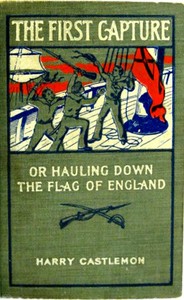
Before opening The First Capture; or, Hauling Down the Flag of England — Themes and Context, the edition data offers a quick orientation: 52,443 words, 3 hr 49 min estimated reading time, and 6 detected text sections.
The text analysis averages about 17.3 words per sentence, while the detected sections provide another way to judge how the source is divided.
Project Gutenberg metadata also associates the work with “War stories,” connecting these edition facts with the source record’s subject description.
Explore this collection
These alternatives are selected using recorded categories and estimated reading time.
About 220 minutes
Exploration Survival Adventure Tales
50,576 recorded words. 9 minutes difference from this book's estimate.
View Gutenberg source #37673About 209 minutes
Exploration Survival Adventure Tales
47,948 recorded words. 20 minutes difference from this book's estimate.
View Gutenberg source #46540About 252 minutes
Exploration Survival Adventure Tales
57,877 recorded words. 23 minutes difference from this book's estimate.
View Gutenberg source #51792Search stored excerpts and compare books → Choose by your preferences →
Choices use stored catalog measurements. Estimates vary with reading speed. A shared category is a catalog label, not a claim that two books have the same argument or literary quality.
Search reads excerpt text stored with this catalog and links to its associated Gutenberg record. The connection is stored in the site database; this tool does not recheck that every excerpt is word-for-word identical to that external record. Excerpt search does not cover every chapter and does not verify historical publication dates.
Catalog snapshot checked: 2026-09-25. Coverage: 95 public books, 95 available source excerpts.
Calculated from edition completeness, EPUB availability, text structure and catalogue metadata. Not a user rating.
Total of 100 points, scaled to a 2.5-5.0 range. Editions with an empty description or a missing EPUB file are not scored.
Public-domain source text
The source text is kept in the dedicated reader, separate from this catalogue record and its commentary.
Harry Castlemon opens The First Capture; or, Hauling Down the Flag of England with a deliberate shift in narrative pace. The first chapter, “The Battle of Lexington,” begins not with action but with a delayed report: the courier’s horse has “his head down and his flanks heaving,” and the men’s excitement is shown through “pale faces and clenched hands” rather than words. This indirect opening establishes a pattern of tension built through physical detail and withheld information. The narrator then steps back to explain the historical context—the lack of telegraphs, the reliance on mounted messengers—before summarizing the battle. The effect is a layered voice that oscillates between immediate scene-setting and explanatory asides, a technique Castlemon uses throughout the excerpts to control the reader’s access to events.
Castlemon’s narrator frequently interjects with historical exposition, as when he notes, “We did not have any telegraph in those days.” This creates a dual voice: one that observes the characters’ immediate actions and another that addresses the reader directly, bridging the gap between 1775 and 1900. In later excerpts, the narrator recedes, letting dialogue and physical description carry the scene. For instance, when Zeb Short disobeys orders and lingers near the church, the narration shifts to a tight third-person focus on his movements and the captain’s reactions. The contrast between the opening’s broad historical summary and the later close-up on individual choices reveals a deliberate modulation of narrative distance, keeping the reader engaged without sacrificing period context.
Castlemon controls pacing by alternating rapid dialogue with descriptive pauses. In the church scene, the captain’s whispered commands and the officers’ silent rising create a swift, almost choreographed sequence: “In an instant the officers arose and followed him.” Yet just before, Zeb’s breathless report—“‘Here we are, OBrien,’ panted Zeb Short, breathing hard after his rapid run”—slows the moment, emphasizing physical exertion. The author also uses repeated gestures, such as Zeke raising his hand “as if to intimate that that was his idea exactly,” to signal impending action without rushing into it. These techniques give the narrative a stop-start rhythm that mirrors the uncertainty of the characters’ plans.
Throughout the excerpts, characters repeatedly watch and misinterpret each other. Zeb Short is told to “keep out of sight of the church” but instead “loafed around there, watching all the people who went in.” The captain, in turn, looks out “cautiously” and notes Zeb’s absence. This mutual surveillance creates a cat-and-mouse dynamic that drives the plot forward. Miscommunication also features: OBrien scolds Zeb for raising a fight, but Zeb insists he was “doing my duty.” The tension between orders and independent action recurs, as when the minister closes the window after the officers escape. These small, repeated details—a glance, a whispered word, a closed window—build a texture of suspicion and improvisation that defines the novel’s early conflicts.
Readers approaching The First Capture should attend to how Castlemon uses narrative voice not merely to tell a story but to shape the reader’s understanding of historical events. The shifts between exposition and immediate action, the careful pacing through physical detail, and the recurring motifs of watching and miscommunication all reward close attention. The excerpts suggest a work that balances adventure with a self-conscious narrator, offering a distinctive reading experience beyond simple plot progression.
That rainy afternoon, under a fraying blanket, The First Capture pulled me into its brisk pacing, but it was the quiet shift in voice—how history folds into personal memory—that lingered. Later, idly tracing that thread, I stumbled on The Gold Kloof — A Closer Reading. There, the same unhurried attention to structural change felt like finding a familiar room in another house.
Create a short personal record of your experience with this book.