About 191 minutes
With the Indians in the Rockies — Reading Notes
Exploration Survival Adventure Tales
43,724 recorded words. 29 minutes difference from this book's estimate.
View Gutenberg source #42274
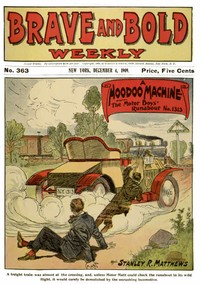
The catalog record for A Hoodoo Machine; or, The Motor Boys' Runabout No. 1313. — A Closer Reading provides practical reading context through 37,042 words, 2 hr 42 min estimated reading time, and 26 detected text sections.
The text analysis averages about 13.1 words per sentence, while the detected sections provide another way to judge how the source is divided.
Project Gutenberg metadata also associates the work with “Adventure stories,” connecting these edition facts with the source record’s subject description.
Explore this collection
These alternatives are selected using recorded categories and estimated reading time.
About 191 minutes
Exploration Survival Adventure Tales
43,724 recorded words. 29 minutes difference from this book's estimate.
View Gutenberg source #42274About 195 minutes
Exploration Survival Adventure Tales
44,764 recorded words. 33 minutes difference from this book's estimate.
View Gutenberg source #39047About 119 minutes
Exploration Survival Adventure Tales
27,358 recorded words. 43 minutes difference from this book's estimate.
View Gutenberg source #44600Search stored excerpts and compare books → Choose by your preferences →
Choices use stored catalog measurements. Estimates vary with reading speed. A shared category is a catalog label, not a claim that two books have the same argument or literary quality.
Search reads excerpt text stored with this catalog and links to its associated Gutenberg record. The connection is stored in the site database; this tool does not recheck that every excerpt is word-for-word identical to that external record. Excerpt search does not cover every chapter and does not verify historical publication dates.
Catalog snapshot checked: 2026-09-25. Coverage: 95 public books, 95 available source excerpts.
Calculated from edition completeness, EPUB availability, text structure and catalogue metadata. Not a user rating.
Total of 100 points, scaled to a 2.5-5.0 range. Editions with an empty description or a missing EPUB file are not scored.
Public-domain source text
The source text is kept in the dedicated reader, separate from this catalogue record and its commentary.
The story opens with a freight train bearing down on a runaway runabout, number 1313, whose driver seems unable to control it. The first chapter, titled “The Car That Wouldn’t Behave,” immediately establishes the central conflict: a machine that defies its operator. The three boys—Matt King, Joe McGlory, and Billy Wells—watch from the Jericho Pike, their dialogue mixing slang and superstition. Billy declares the car a “hoodoo” because of its double-thirteen tag, a claim that sets the tone for the mechanical mischief to follow. The excerpt shows the car as an active antagonist, swerving and threatening to “turn turtle,” while the boys’ banter reveals their distinct voices: Joe’s colorful exclamations, Billy’s folk wisdom, and Matt’s calm assessment. This opening primes readers for a tale where the machine itself is the puzzle.
The runabout number 1313 is not merely a vehicle but a source of agency and mystery. From the first chapter, it “won’t be controlled,” and Billy’s superstition about the number is echoed in the title. The car’s behavior—wild, unpredictable, nearly causing a collision—suggests a mechanical curse rather than driver error. Later excerpts, such as Chapter XI, show the car being moved without Matt’s knowledge, hinting at a larger scheme. The hoodoo motif recurs in the dialogue: Joe’s “sufferin’ whirligigs” and Billy’s “double hoodoo” frame the car as a supernatural force. Readers should watch how the machine’s actions drive the plot, often independent of human intent.
The three protagonists are distinguished by their speech patterns. Matt King speaks in measured, logical sentences, as when he says “I should say it’s the car that’s ‘bug.’” Joe McGlory uses hyperbolic exclamations like “Sufferin’ whirligigs” and “bug with a big ‘B,’” while Billy Wells relies on folk sayings and superstition. This vocal variety creates a natural rhythm in dialogue, with each boy reacting differently to danger. In Chapter XI, Matt’s internal questioning—“Why hadn’t McGlory and Levitt gone to the city?”—shows his analytical mind at work. The interplay of these voices, especially in tense moments, gives the story a conversational energy that propels the reader through the dime-novel format.
In Chapter XI, Uncle Tom emerges as a key ally, speaking in a heavy dialect that marks him as a stock character of the period. His lines—“Marse Kelly would kill me daid”—and his faulty arithmetic (“five times fo’ is fifty”) reflect racial stereotypes common in early 20th-century adventure fiction. Yet his actions are heroic: he risks his job to free Matt, showing loyalty and courage. The excerpt reveals his physical frailty (“rheumatic legs”) and his fear of Kelly, but also his determination. Readers should note how Uncle Tom’s dialect contrasts with the boys’ speech, and how his character serves both as comic relief and as a plot device to enable Matt’s escape.
As a dime novel from Brave and Bold Weekly, the story is built for serial consumption. Each chapter ends with a cliffhanger or a new complication. The opening excerpt throws the reader into immediate peril; later chapters, like “Uncle Tom Again,” resolve one crisis while setting up another. The table of contents shows a mix of action (“HURLING A BOMB”) and mystery (“A STARTLING MYSTERY”). The pacing is swift, with short chapters and frequent shifts in location—from the Jericho Pike to the garage to the golf links. Readers should expect rapid scene changes and a focus on immediate events rather than deep characterization. The serial format rewards attention to recurring details, such as the car’s number and the characters’ catchphrases.
For a first reading, pay attention to how the car’s hoodoo reputation evolves from a joke into a genuine plot driver. The excerpts suggest that the machine’s misbehavior may be linked to human scheming, not just bad luck. The boys’ distinct voices and Uncle Tom’s dialect offer clues to the story’s social assumptions and its serialized structure. Let the rapid pace carry you through the chapters, and note how each twist redefines the central mystery of the runabout.
Some afternoons I think of that hoodoo runabout, all rattling charm and stubborn luck, and how its boys trusted the machine despite every grumble. There’s a similar warmth in With the Indians in the Rockies — Reading Notes—a quiet faith in rough country and older friends, a companionship that asks nothing but patience. Two books, different trails, same steady heartbeat.
Answer a few questions and save a private reflection on this device.