About 162 minutes
A Hoodoo Machine; or, The Motor Boys' Runabout No. 1313. — A Closer Reading
Exploration Survival Adventure Tales
37,042 recorded words. 43 minutes difference from this book's estimate.
View Gutenberg source #53607
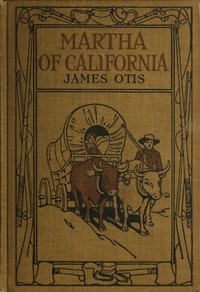
For Martha of California: A Story of the California Trail — Key Ideas to Explore, the stored edition analysis reports 27,358 words, 1 hr 59 min estimated reading time, and 4 detected text sections.
The text analysis averages about 36.2 words per sentence, while the detected sections provide another way to judge how the source is divided.
Project Gutenberg metadata also associates the work with “Overland journeys to the Pacific -- Juvenile fiction,” connecting these edition facts with the source record’s subject description.
Explore this collection
These alternatives are selected using recorded categories and estimated reading time.
About 162 minutes
Exploration Survival Adventure Tales
37,042 recorded words. 43 minutes difference from this book's estimate.
View Gutenberg source #53607About 191 minutes
Exploration Survival Adventure Tales
43,724 recorded words. 72 minutes difference from this book's estimate.
View Gutenberg source #42274About 195 minutes
Exploration Survival Adventure Tales
44,764 recorded words. 76 minutes difference from this book's estimate.
View Gutenberg source #39047Search stored excerpts and compare books → Choose by your preferences →
Choices use stored catalog measurements. Estimates vary with reading speed. A shared category is a catalog label, not a claim that two books have the same argument or literary quality.
Search reads excerpt text stored with this catalog and links to its associated Gutenberg record. The connection is stored in the site database; this tool does not recheck that every excerpt is word-for-word identical to that external record. Excerpt search does not cover every chapter and does not verify historical publication dates.
Catalog snapshot checked: 2026-09-25. Coverage: 95 public books, 95 available source excerpts.
Calculated from edition completeness, EPUB availability, text structure and catalogue metadata. Not a user rating.
Total of 100 points, scaled to a 2.5-5.0 range. Editions with an empty description or a missing EPUB file are not scored.
Public-domain source text
The source text is kept in the dedicated reader, separate from this catalogue record and its commentary.
Martha of California is told in the first person by a young girl on the overland journey to California, a perspective that keeps the narrative close to immediate sensory details—the feel of a wagon, the taste of prairie peas, the sight of a wagon toppling slowly into a creek. The story moves from one encampment or landmark to the next, with chapter headings such as “The First Encampment,” “A Stormy Day,” and “Chimney Rock” marking the progress. Rather than dwelling on grand adventures, the text lingers on the small, often awkward moments of travel: making butter on the trail, laughing at a neighbor’s mishap, or the disappointment of passing a curiosity without stopping.
The structure of Martha of California is episodic, built around discrete events rather than a continuous plot. The table of contents lists nearly forty short chapters, each focused on a single occurrence: “Making Camp in a Storm,” “A Thunderstorm,” “The Stock Stray Away,” “Making Butter.” This arrangement mirrors the rhythm of the trail itself, where each day brings a new challenge or observation. Martha’s narration often begins a chapter with a direct statement of what happened, as in “When finally we crossed the Platte River, the men of the company rejoiced,” then expands with her own commentary. The effect is that the journey feels like a series of vivid snapshots, with the reader sharing Martha’s alternating boredom, curiosity, and relief.
Water appears repeatedly as both a necessity and a source of trouble. The crossing of the Platte is marked by relief, but earlier the company suffers from thirst, and later a wagon overturns in a creek, spilling out Mrs. Russell and her children “exactly like a lot of grasshoppers.” Mud and wet clothing are described with comic precision. Another recurring image is the contrast between what Martha wants to see—such as Chimney Rock—and the adults’ refusal to delay. Eben Jordan’s solo ride to the rock and his dismissive description of it as “a lot of big stones that looked as if they might have been carelessly plastered together with mud” deflates the wonder, but also shows Martha’s wry awareness of different ways of seeing.
The narrative shifts between the cramped interior of the wagon and the open landscape outside. Martha often notes the contrast: after weeks in the wagon, sleeping in a real house at Fort Laramie seems “almost beautiful,” yet the house is swarming with mosquitoes. The wagon is described as a “movable home,” and much of the story’s tension comes from the friction between Martha’s desire for comfort and the relentless forward motion demanded by the adults. Father’s gruff refusal to halt for sightseeing—“we who were bent on finding new homes had no time to fritter away”—underscores the pressure of the journey. The movement is not just physical but emotional, as Martha shifts from weariness to laughter to disappointment within a few paragraphs.
Martha’s voice is distinctive for its blend of earnestness and dry humor. She admits to laughing at the Russell family’s accident even while knowing she should not, and she notes that her mother could barely keep a straight face while scolding. This self-awareness gives the narrative a conversational, almost confiding tone. Her observations are concrete: the number of miles from Independence to Fort Laramie (672), the way the wagon toppled “slowly,” the order in which children emerged from the water. She does not moralize heavily, but lets the details speak. Eben Jordan serves as a foil—his lack of appreciation for scenery allows Martha to define her own curiosity. The result is a story that feels less like a lesson and more like a child’s genuine record of a difficult, sometimes funny, journey.
Readers approaching Martha of California will find a narrative that rewards attention to small moments rather than dramatic arcs. The book’s strength lies in its accumulation of specific, often homely details—the taste of prairie peas, the feel of mud-soaked clothes, the disappointment of passing a landmark unseen. Martha’s voice, at once observant and wry, invites readers to share her perspective without sentimentality. The journey is the story, and the story is in the details.
Martha’s constant hunger and the dust that followed every wagon made me think of the older trail stories I once lingered over, like With the Indians in the Rockies — Reading Notes. Both books keep that same stubborn weather and quiet worry close, as if time never really smoothed those paths. I still feel the grit on my tongue.
Build a private reading journal entry for this title.