About 400 minutes
The Mesmerist's Victim — Context and Discussion
Technology Airships Imagined Futures
91,881 recorded words. 69 minutes difference from this book's estimate.
View Gutenberg source #42690
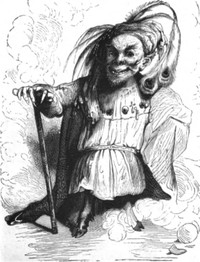
Asmodeus; or, The Devil on Two Sticks — Context and Discussion can be approached with a clearer sense of reading commitment from its source measurements: 107,725 words, 7 hr 49 min estimated reading time, and 14 detected text sections.
The text analysis averages about 26.5 words per sentence, while the detected sections provide another way to judge how the source is divided.
Project Gutenberg metadata also associates the work with “Madrid (Spain) -- Fiction,” connecting these edition facts with the source record’s subject description.
Explore this collection
These alternatives are selected using recorded categories and estimated reading time.
About 400 minutes
Technology Airships Imagined Futures
91,881 recorded words. 69 minutes difference from this book's estimate.
View Gutenberg source #42690About 377 minutes
Technology Airships Imagined Futures
86,656 recorded words. 92 minutes difference from this book's estimate.
View Gutenberg source #47279About 369 minutes
Technology Airships Imagined Futures
84,661 recorded words. 100 minutes difference from this book's estimate.
View Gutenberg source #39834Search stored excerpts and compare books → Choose by your preferences →
Choices use stored catalog measurements. Estimates vary with reading speed. A shared category is a catalog label, not a claim that two books have the same argument or literary quality.
Search reads excerpt text stored with this catalog and links to its associated Gutenberg record. The connection is stored in the site database; this tool does not recheck that every excerpt is word-for-word identical to that external record. Excerpt search does not cover every chapter and does not verify historical publication dates.
Catalog snapshot checked: 2026-09-25. Coverage: 95 public books, 95 available source excerpts.
Calculated from edition completeness, EPUB availability, text structure and catalogue metadata. Not a user rating.
Total of 100 points, scaled to a 2.5-5.0 range. Editions with an empty description or a missing EPUB file are not scored.
Public-domain source text
The source text is kept in the dedicated reader, separate from this catalogue record and its commentary.
The translator's preface immediately signals a departure: Joseph Thomas explains that he undertook a fresh translation after finding the existing English version lacked the 'style' and 'verbal melody' of Le Sage's original. He adopts Janin's biographical notice rather than writing his own, and notes the controversy over the work's debt to Luis Velez de Guevara's Diablo Cojuelo.
The excerpts plunge us into a nocturnal Madrid where the devil Asmodeus—called 'the Cripple'—lifts rooftops to reveal the city's inhabitants. Don Cleophas Leandro Perez Zambullo, a student, serves as the astonished observer. The devils commentary is brisk and satirical, targeting collectors, courtiers, card players, and an old bachelor obsessed with women's shoes.
The excerpts establish a distinctive narrative mechanism: Asmodeus and Don Cleophas move from rooftop to rooftop, peering into houses. The devil points out individuals and delivers crisp, mocking summaries of their obsessions. One man buys furniture only to pack it away for posthumous inventory; another loiters in ministerial antechambers to create the illusion of influence. The student's reactions—laughter, disbelief, and the occasional wry remark—anchor the reader's response.
Le Sage's prose, even in translation, favors direct speech and rapid characterization. The devil's tone is worldly and amused, never moralizing. He presents each case as a specimen of human absurdity, and the student's questions keep the dialogue moving. The setting—a city seen from above at night—gives the satire a theatrical quality, as if the reader is watching a series of short plays.
Joseph Thomas's preface is unusually candid about the challenges of rendering Le Sage into English. He criticizes the earlier version for its 'total absence of style' and admits he does not always translate literally, aiming instead to convey the 'ideas which those words import.' This self-awareness colors the reading experience: the text we have is a deliberate reinterpretation, not a transparent window onto the French original.
Thomas also adopts Jules Janin's biographical notice, which describes Le Sage as a 'Devil truly French.' The preface thus frames the work as both a literary artifact and a translation project. Readers may notice moments where the English feels slightly formal or period-specific—'cavalier,' 'devoirs,' 'auditor of the court'—which reflect Thomas's effort to balance fidelity with readability.
The excerpts reveal a recurring structure: Asmodeus identifies a person, describes their peculiar behavior, and Don Cleophas responds with surprise or laughter. The devil then often adds a second, related example, creating a cumulative effect. For instance, after the collector of packed-away furniture, he presents the old bachelor from the Philippines who pretends to have court connections. The student's comment—'An amusing original, indeed!'—prompts the devil to offer more cases.
This pattern suggests that the full book will proceed as a series of such vignettes, linked by the framing device of the rooftop journey. The satirical targets are varied—vanity, avarice, lust, social climbing—but the method remains consistent: expose the gap between public appearance and private folly. The devil's tone is never angry; he seems to enjoy the spectacle.
The provided text covers only the translator's preface and a few early episodes. We do not see how the story begins (how Don Cleophas meets Asmodeus) or ends. The excerpts give no indication of a larger plot—no overarching conflict, no character development beyond the student's role as a sounding board. The devil's own motives remain unclear; he says he 'esteems' one old bachelor who is 'formed in my own mould,' but this hint of self-identification is not elaborated.
Readers should expect the book to maintain its episodic structure, with the devil as a consistent, ironic narrator. The translation's style, as established in the preface, will likely prioritize clarity and wit over archaic flourish. The illustrations by Tony Johannot, mentioned on the title page, are not represented in the excerpts but may add visual commentary.
Approach this edition as a performance of translation as much as a novel. Thomas's preface invites us to compare his choices with the original's reputation for 'verbal melody,' and the early episodes demonstrate his method: brisk dialogue, pointed characterization, and a light satirical touch. The devil's rooftop tour is a flexible frame, not a tight plot, so readers can dip in and out of episodes. Pay attention to the rhythm of Asmodeus's speech—it carries the book's energy.
There’s something about the way Asmodeus lifts the rooftops off Madrid, showing every private ache beneath, that stayed with me. That same quiet tenderness for flawed people seems to live in After the Divorce: A Romance — Reading Companion. It left a soft ache, like recognizing a friend’s sigh before they speak.
Save your reaction, strongest insight, and memorable passage.