About 888 minutes
The Decameron (Day 1 to Day 5) Containing an hundred pleasant Novels — Reading Companion
Technology Airships Imagined Futures
204,128 recorded words. 22 minutes difference from this book's estimate.
View Gutenberg source #52617
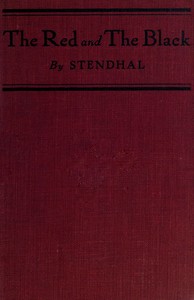
The Red and the Black: A Chronicle of 1830 — Context and Discussion can be approached with a clearer sense of reading commitment from its source measurements: 198,957 words, 14 hr 26 min estimated reading time, and 17 detected text sections.
The text analysis averages about 17.1 words per sentence, while the detected sections provide another way to judge how the source is divided.
Project Gutenberg metadata also associates the work with “Bildungsromans,” connecting these edition facts with the source record’s subject description.
Explore this collection
These alternatives are selected using recorded categories and estimated reading time.
About 888 minutes
Technology Airships Imagined Futures
204,128 recorded words. 22 minutes difference from this book's estimate.
View Gutenberg source #52617About 469 minutes
Technology Airships Imagined Futures
107,725 recorded words. 397 minutes difference from this book's estimate.
View Gutenberg source #51145About 400 minutes
Technology Airships Imagined Futures
91,881 recorded words. 466 minutes difference from this book's estimate.
View Gutenberg source #42690Search stored excerpts and compare books → Choose by your preferences →
Choices use stored catalog measurements. Estimates vary with reading speed. A shared category is a catalog label, not a claim that two books have the same argument or literary quality.
Search reads excerpt text stored with this catalog and links to its associated Gutenberg record. The connection is stored in the site database; this tool does not recheck that every excerpt is word-for-word identical to that external record. Excerpt search does not cover every chapter and does not verify historical publication dates.
Catalog snapshot checked: 2026-09-25. Coverage: 95 public books, 95 available source excerpts.
Calculated from edition completeness, EPUB availability, text structure and catalogue metadata. Not a user rating.
Total of 100 points, scaled to a 2.5-5.0 range. Editions with an empty description or a missing EPUB file are not scored.
Public-domain source text
The source text is kept in the dedicated reader, separate from this catalogue record and its commentary.
Stendhal's The Red and the Black opens with a translator's introduction that frames the novel as intimately tied to its author's life. Horace B. Samuel presents Julien Sorel as a figure who, viewed superficially, is a cad and an assassin, yet one who alternates between sentiment and ferocity. The introduction quotes Stendhal's own defensive remark: 'In the time of the Emperor, Julien would have passed for a very honest man.' This sets up a central tension between personal ambition and the moral codes of a society that has lost its Napoleonic compass.
The excerpts from the novel itself show Julien observing the aristocratic salon of the Hôtel de la Mole with a critical eye. He notes the 'stifling moral atmosphere,' the boredom masked by ices and champagne, and the servants who appear in livery every quarter-hour. The word 'crusade' alone commands genuine respect among the nobles, while their ordinary courtesy carries condescension. Julien's discomfort is palpable: he finds dining with the family 'the most painful part of my employment,' preferring a forty-sous dinner at an obscure inn.
Horace B. Samuel's introduction does not merely summarize; it actively shapes the reader's expectations. He describes Julien as 'a cad, a scoundrel, an assassin' who nonetheless commands a 'moist eye of the sentimentalist' alongside a 'ferocious grin of the beast of prey.' This duality is presented without apology. Samuel notes that Stendhal 'wallows defiantly in his own alleged wickedness,' quoting the author's retort that under the Emperor, Julien would have been considered honest. The translator also sketches Stendhal's own biography—a childhood orphaned of his mother, hated by his father, and marked by a 'compound of sensibility and hard rebelliousness.' This biographical lens suggests that Julien's character is not merely invented but emerges from the author's own experiences of social climbing and resentment.
In the excerpt from the novel, Julien observes the salon of the Hôtel de la Mole with anthropological detachment. The guests are divided by their newspapers—four swear by La Quotidienne, three by La Gazette de France—and their conversation is so hollow that Julien wonders if they are mocking themselves. He recalls that his own reading of de Maistre is superior to their talk. The boredom is so acute that some guests console themselves with ices or the prestige of having been at the Hôtel. Julien learns that Madame de la Mole rewarded twenty years of a baron's attendance with a prefecture, a fact that whets the zeal of other toadies. The marquis and his wife openly express 'sincere contempt for everyone who was not sprung from people entitled to ride in the carriages of the king.' Julien's only interest is the marquis himself, whose denial of involvement in the promotion reveals the intricate dance of patronage.
A key moment occurs when Julien, working with the abbé Pirard, asks whether dining with the family is a duty or a favour. The abbé, scandalized, calls it a 'special honour' that even a fifteen-year academician could not obtain. Julien confesses he finds it 'the most painful part of my employment,' preferring the seminary's austerity. He requests permission to eat at a cheap inn. The abbé, a 'true snob,' tries to correct him, but they are overheard by Mademoiselle de la Mole. She hears Julien's complaint and begins to respect him, thinking, 'He has not been born servile, like that old abbé.' At dinner, she speaks to him kindly. This reversal—where the servant's honesty earns the noblewoman's regard—highlights the novel's exploration of merit versus birth, and the precarious position of a talented commoner in a stratified society.
Readers approaching The Red and the Black should attend to the interplay between the translator's framing and the novel's own scenes. Samuel's introduction offers a lens of biographical resentment and Napoleonic nostalgia, while the excerpts show Julien's sharp observations of aristocratic hypocrisy. The tension between Julien's inner life and his social performance is the novel's engine. Pay close attention to how Stendhal uses small details—a word like 'crusade,' the number of crosses on a guest's chest, the timing of ices—to build a world where every gesture carries political and class weight.
Sometimes I think of Julien Sorel’s restless hunger, that ache for a life just out of reach, and it reminds me of the quieter, smiling defiance I found in Laughing Last — Themes and Context. It’s a different sort of triumph—not storming the barricades, but simply outlasting them. That old book felt like a warm, ironic hug.
Capture what you thought, learned, and would like to remember.