About 866 minutes
The Red and the Black: A Chronicle of 1830 — Context and Discussion
Technology Airships Imagined Futures
198,957 recorded words. 22 minutes difference from this book's estimate.
View Gutenberg source #44747
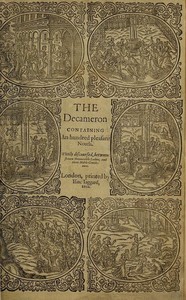
Before opening The Decameron (Day 1 to Day 5) Containing an hundred pleasant Novels — Reading Companion, the edition data offers a quick orientation: 204,128 words, 14 hr 48 min estimated reading time, and 17 detected text sections.
The text analysis averages about 41.4 words per sentence, while the detected sections provide another way to judge how the source is divided.
Project Gutenberg metadata also associates the work with “Plague -- Europe -- History -- Fiction,” connecting these edition facts with the source record’s subject description.
Explore this collection
These alternatives are selected using recorded categories and estimated reading time.
About 866 minutes
Technology Airships Imagined Futures
198,957 recorded words. 22 minutes difference from this book's estimate.
View Gutenberg source #44747About 469 minutes
Technology Airships Imagined Futures
107,725 recorded words. 419 minutes difference from this book's estimate.
View Gutenberg source #51145About 400 minutes
Technology Airships Imagined Futures
91,881 recorded words. 488 minutes difference from this book's estimate.
View Gutenberg source #42690Search stored excerpts and compare books → Choose by your preferences →
Choices use stored catalog measurements. Estimates vary with reading speed. A shared category is a catalog label, not a claim that two books have the same argument or literary quality.
Search reads excerpt text stored with this catalog and links to its associated Gutenberg record. The connection is stored in the site database; this tool does not recheck that every excerpt is word-for-word identical to that external record. Excerpt search does not cover every chapter and does not verify historical publication dates.
Catalog snapshot checked: 2026-09-25. Coverage: 95 public books, 95 available source excerpts.
Calculated from edition completeness, EPUB availability, text structure and catalogue metadata. Not a user rating.
Total of 100 points, scaled to a 2.5-5.0 range. Editions with an empty description or a missing EPUB file are not scored.
Public-domain source text
The source text is kept in the dedicated reader, separate from this catalogue record and its commentary.
John Florio's 1620 translation of Boccaccio's Decameron (Days 1–5) opens with a dedicatory epistle that frames the work as a collection of 'singular and exquisite Histories' intended to reveal vice and virtue. The excerpts show a structure where ten young people—seven ladies and three gentlemen—retreat from plague-stricken Florence to tell tales over ten days. Each day has a theme, and the stories are embedded within a frame narrative that itself comments on storytelling and morality.
The translation retains the original's layered voices: the authorial preface, the narrators' debates, and the characters' speeches. Florio's English is ornate and rhythmic, with long sentences and rhetorical flourishes that mirror Boccaccio's Italian prose. The excerpts include a tale of seduction and remorse, where Ricciardo's cunning and Catulla's shame lead to mutual destruction, illustrating the work's recurring interest in the consequences of desire and deception.
The Decameron employs a frame story that is not merely a container but an active part of the work's meaning. The ten storytellers are introduced in the epistle as 'seaven Honourable Ladies, and three Noble Gentlemen' who flee the plague. Their conversations between tales create a second layer of commentary. In the excerpts, the frame is established through the dedicatory epistle, which argues that reading histories teaches wisdom by 'resorting to the dead.' This meta-note sets up the tales as instructive examples.
The structure is recursive: within a tale, characters often tell stories themselves, or their actions mirror the themes of the frame. For instance, Ricciardo's manipulation of Catulla echoes the storytellers' own rhetorical skills. The frame also provides relief from the plague's horror, as the company's garden setting contrasts with the city's decay. This nesting of narratives allows Boccaccio to explore multiple perspectives on love, fortune, and wit without a single authorial judgment.
Throughout the excerpts, physical and psychological confinement recurs. The plague confines the city's inhabitants to death; the storytellers voluntarily confine themselves to a rural villa. Within tales, characters are trapped in baths, bedrooms, or marriages. In the Ricciardo and Catulla story, the lady is 'leapt out of the Bath' but cannot escape, and later she 'recovered her owne house' only to be imprisoned by remorse. The bath itself is a confined space where deception occurs.
Escape is often illusory or leads to further entrapment. Catulla's flight from Ricciardo results in a 'fierce melancholy' that kills her. The pilgrim Thebaldo, mentioned in another excerpt, returns in disguise, suggesting that identity and freedom are fluid. These images of confinement—plague, bath, house, melancholy—create a pattern where characters' attempts to break free often tighten the bonds. The frame story's escape from plague is temporary, as the tales themselves return to themes of entrapment.
The excerpts show rapid shifts in setting and tone. The dedicatory epistle is formal and philosophical, citing Zeno and King Ptolemy. Then the narrative moves to the plague's horrors (implied), then to a garden of storytelling, then into a tale that begins with seduction and ends with death. Within the Ricciardo tale, the scene moves from a public street to a private bath, then to Catulla's house, and finally to a wilderness hermitage. Each shift changes the register: from witty dialogue to tearful persuasion to tragic outcome.
Boccaccio often juxtaposes comic and serious moments. Ricciardo's initial trick is almost farcical, but his tears and Catulla's 'tormenting passions' turn it tragic. The storytellers themselves move between laughter and moral reflection. This constant motion prevents any single mood from dominating, reflecting the work's claim to represent 'all Vices in their ugly deformities' and 'sacred Vertues.' The reader is carried along these shifts, never settling into one perspective.
John Florio's translation gives the Decameron a distinctive English voice. His sentences are long and periodic, with clauses piled up: 'The Philosopher Zeno (Right Honourable, and my most worthily esteemed Lord) being demaunded on a time by what meanes a man might attaine to happinesse; made answere...' This Latinate syntax suits the epistle's formal tone. In the tales, however, dialogue becomes more direct. Ricciardo's speech uses rhetorical questions and parallel structures: 'what is done, cannot now be undone' and 'you are not the first, neither can be the last.'
Florio also employs vivid physical details: 'teares streaming aboundantly downe his cheekes' and 'shee would have leapt out of the Bath.' The translation preserves Boccaccio's balance between abstract moralizing and concrete action. The narrator's voice in the frame is measured, while characters speak with passion. This variety in register—from the epistle's gravity to the tale's urgency—demonstrates Florio's skill in rendering Boccaccio's stylistic range. Readers attentive to language will note how the translation shapes the work's emotional impact.
This edition of the first five days offers a substantial portion of Boccaccio's masterpiece in a historical translation that itself rewards study. Readers may wish to attend to how the frame story's progress—each day with its own king or queen—organizes the tales and how the narrators' personalities emerge through their choices. The interplay between the plague's reality and the garden's artifice remains a central tension, reminding us that storytelling is both an escape and a confrontation with human nature.
I keep thinking about how Boccaccio’s storytellers build worlds to escape their own fears, each tale a small shelter. That quiet urgency surfaced again in The Planet Mappers — Reading Companion, where mapping unknown places becomes its own kind of comfort. It stayed with me like a familiar voice, unhurried and strangely warm.
Your answers remain private and are stored only in this browser.