About 363 minutes
A Little Girl in Old Pittsburg — Themes and Context
Historical Psychological Social Fiction
83,403 recorded words. 2 minutes difference from this book's estimate.
View Gutenberg source #43769
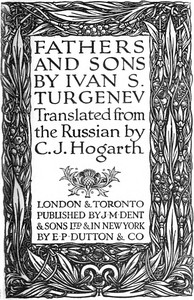
Before opening Fathers and Sons — Reading Companion, the edition data offers a quick orientation: 83,833 words, 6 hr 5 min estimated reading time, and 9 detected text sections.
The text analysis averages about 16.0 words per sentence, while the detected sections provide another way to judge how the source is divided.
Project Gutenberg metadata also associates the work with “Historical fiction,” connecting these edition facts with the source record’s subject description.
Explore this collection
These alternatives are selected using recorded categories and estimated reading time.
About 363 minutes
Historical Psychological Social Fiction
83,403 recorded words. 2 minutes difference from this book's estimate.
View Gutenberg source #43769About 356 minutes
Historical Psychological Social Fiction
81,657 recorded words. 9 minutes difference from this book's estimate.
View Gutenberg source #53468About 344 minutes
Historical Psychological Social Fiction
78,908 recorded words. 21 minutes difference from this book's estimate.
View Gutenberg source #41879Search stored excerpts and compare books → Choose by your preferences →
Choices use stored catalog measurements. Estimates vary with reading speed. A shared category is a catalog label, not a claim that two books have the same argument or literary quality.
Search reads excerpt text stored with this catalog and links to its associated Gutenberg record. The connection is stored in the site database; this tool does not recheck that every excerpt is word-for-word identical to that external record. Excerpt search does not cover every chapter and does not verify historical publication dates.
Catalog snapshot checked: 2026-09-25. Coverage: 95 public books, 95 available source excerpts.
Calculated from edition completeness, EPUB availability, text structure and catalogue metadata. Not a user rating.
Total of 100 points, scaled to a 2.5-5.0 range. Editions with an empty description or a missing EPUB file are not scored.
Public-domain source text
The source text is kept in the dedicated reader, separate from this catalogue record and its commentary.
The excerpts from Turgenev's Fathers and Sons show a novel that is less a straightforward polemic than a study of how ideas falter in close relationships. The catalog subjects list nihilism, domestic fiction, and social conditions, but the text itself dwells on awkward silences, half-quizzical banter, and characters who cannot say what they feel. When Bazarov announces his departure to Arkady, he yawns and turns his face to the wall; Arkady, in turn, reflects on his own motives without voicing them. The narrator’s eye for the paltry—Sitnikov’s entrance, a hat sat upon—underscores how trivial incidents defuse tension and expose self-regard.
The excerpts repeatedly show conflict expressed through posture and silence rather than debate. After Bazarov and Arkady return from Nikolsköe, they develop “half-quizzical relations which are always a sign of tacit distrust and a smouldering grudge.” Bazarov yawns when Arkady probes his mood; he turns his face to the wall and gives curt replies. Arkady, lying in bed, raises himself on his elbow but cannot bring himself to ask the obvious question. The narrator does not explain their feelings but lets the physical details—a yawn, a turned back, a propped elbow—carry the weight of estrangement. This technique aligns with the novel’s reputation for psychological realism, yet the excerpts offer no interior monologue; instead, the reader infers tension from what is left unsaid.
The introduction claims Bazarov embodies nihilism, but the excerpts show his ideas more as a social pose than a coherent philosophy. When Arkady quotes Bazarov’s own words back at him—“Why are you down-hearted? Have you just fulfilled a sacred duty?”—Bazarov ignores the jab and changes the subject. His reply, “When you are come to be a little older, you will know more,” is a deflection, not an argument. Later, he insists “I am not her hireling” when asked about Anna Sergievna, but the context suggests wounded pride rather than ideological consistency. The narrator’s comment that Sitnikov’s arrival “relaxes over-taut strings” and “sobers natures prone to conceit” implies that even the most self-assured characters are vulnerable to deflation. The excerpts thus complicate the catalog subject of nihilism by showing it as a fragile performance, easily punctured by embarrassment or unspoken affection.
The novel’s domestic settings—bedrooms, tea tables, supper rooms—become arenas where social and emotional tensions play out. Bazarov locks himself in his room after a difficult conversation; Arkady and Bazarov talk in bed, but the intimacy of the setting only highlights their growing distance. At Nikolsköe, Anna Sergievna “yearned to say something kind” but could find no words, and the awkwardness is broken only by the butler announcing an unwelcome guest. The supper that follows is described as “duller and a trifle more futile,” yet the company eats with better appetite and parts earlier. The narrator’s attention to these small domestic rhythms—a locked door, a missed cue, a meal that improves after tension—grounds the ideological conflict in everyday behavior. The catalog labels this “domestic fiction,” and the excerpts confirm that the home is not a refuge but a stage for the very social frictions the novel examines.
Readers approaching Fathers and Sons should attend to what the characters do not say. The excerpts reward attention to physical detail—a yawn, a turned back, a hat sat upon—as much as to ideological speeches. The novel’s power lies not in resolving the conflict between generations but in showing how ideas become entangled with pride, embarrassment, and the difficulty of speaking plainly. The catalog subjects provide a map, but the text itself offers a more intimate, awkward terrain.
I’ve often thought Bazarov’s forced bravado hides a loneliness that speaks to any young soul’s quest for meaning. Decades later, I found that same quiet ache in Judy Bolton’s restless pursuit of truth. The Yellow Phantom A Judy Bolton Mystery — Reading Companion reminds me how mystery, like nihilism, often masks a tender heart. We all wear armor now and then.
Build a private reading journal entry for this title.