About 243 minutes
The Sky Detectives; Or, How Jack Ralston Got His Man — Text and Context
Historical Psychological Social Fiction
55,730 recorded words. 0 minutes difference from this book's estimate.
View Gutenberg source #45776
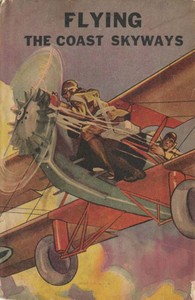
For Flying the Coast Skyways; Or, Jack Ralston's Swift Patrol — Story, Setting & Ideas, the stored edition analysis reports 55,766 words, 4 hr 3 min estimated reading time, and 30 detected text sections.
The text analysis averages about 31.0 words per sentence, while the detected sections provide another way to judge how the source is divided.
Project Gutenberg metadata also associates the work with “Detective and mystery stories,” connecting these edition facts with the source record’s subject description.
Explore this collection
These alternatives are selected using recorded categories and estimated reading time.
About 243 minutes
Historical Psychological Social Fiction
55,730 recorded words. 0 minutes difference from this book's estimate.
View Gutenberg source #45776About 240 minutes
Historical Psychological Social Fiction
55,095 recorded words. 3 minutes difference from this book's estimate.
View Gutenberg source #53440About 256 minutes
Historical Psychological Social Fiction
58,748 recorded words. 13 minutes difference from this book's estimate.
View Gutenberg source #51354Search stored excerpts and compare books → Choose by your preferences →
Choices use stored catalog measurements. Estimates vary with reading speed. A shared category is a catalog label, not a claim that two books have the same argument or literary quality.
Search reads excerpt text stored with this catalog and links to its associated Gutenberg record. The connection is stored in the site database; this tool does not recheck that every excerpt is word-for-word identical to that external record. Excerpt search does not cover every chapter and does not verify historical publication dates.
Catalog snapshot checked: 2026-09-25. Coverage: 95 public books, 95 available source excerpts.
Calculated from edition completeness, EPUB availability, text structure and catalogue metadata. Not a user rating.
Total of 100 points, scaled to a 2.5-5.0 range. Editions with an empty description or a missing EPUB file are not scored.
Public-domain source text
The source text is kept in the dedicated reader, separate from this catalogue record and its commentary.
From its opening line—'Big smoke dead ahead, partner!'—Ambrose Newcomb's Flying the Coast Skyways establishes a pattern of aerial observation that governs both plot and prose. The narrative moves constantly between the cockpit and the ground, with Jack Ralston and his sidekick Perk scanning the landscape below for signs of illicit activity. This vertical structure is reinforced by the recurring image of the 'amphibian' plane, a 'duck' that can land on water and rise again, embodying the story's own fluid transitions between sky and earth.
The story's structure is built around repeated flights that serve as framing devices for each phase of the action. Chapters open with the plane in motion, often with Jack and Perk discussing their next move while scanning the terrain below. This aerial viewpoint allows Newcomb to compress geography: rivers that 'meander along in their long march to the sea, covering at least ten miles where a crow would fly the same distance in one mile' are seen whole, and the narrative can jump between locations without the constraints of ground travel. The plane becomes a mobile observation post, and the reader's understanding of the plot is filtered through this elevated, detached perspective.
Perk's shifting dialect is one of the book's most distinctive features. He consciously adopts a Southern 'cracker' speech—using 'reckons' and 'suh'—as part of his cover, but his natural voice slips through in phrases like 'hot-diggety-dig' and references to a 'Canuck' past. Jack warns him that this 'mixture' might 'queer the big game,' highlighting the tension between performance and authenticity. The dialogue is rendered phonetically, creating a dense, textured soundscape that contrasts with the clean, technical language of flight. This linguistic play is not merely decorative; it signals the characters' constant role-playing and the precariousness of their undercover mission.
Newcomb uses two recurring images to describe the investigation: the 'fine tooth comb' and the 'net.' Jack proposes to 'go over that first fifty or sixty miles again, with a fine tooth comb,' suggesting a meticulous, methodical search from above. Later, a chapter is titled 'Spinning the Net,' implying a trap being woven across the coastal landscape. These metaphors are drawn from craft and labor, grounding the high-tech aerial patrol in older, tactile forms of work. The plane itself is described as 'built to imitate a duck,' an amphibian that belongs to both air and water, reinforcing the theme of hybridity and adaptation that runs through the story.
The narrative alternates between airborne reconnaissance and ground-level action, with each flight segment serving as a prelude to a landing that shifts the scene. In the excerpts, a typical sequence begins with the plane in flight, moves to a discussion of what has been observed, and ends with a decision to land or change course. This rhythm creates a sense of constant motion, but also of waiting and watching. The chapters 'By the Skin of Their Teeth' and 'Ships Passing in the Night' suggest near-misses and missed connections, while 'The Lonely Camp' and 'The Mother Ship' hint at isolated ground locations that become focal points. The structure thus mirrors the patrol's own tension between speed and patience.
Readers attentive to the interplay between aerial and terrestrial scenes will find that Newcomb uses the plane not just as a vehicle but as a structuring principle. The story's movement—from sky to ground, from observation to action—is its organizing logic. Pay particular attention to how each flight reorients the characters' knowledge and how the landscape below is described: as a 'checkered landscape' or a 'tangled mass of forest growth,' it is always seen from above, always partially obscured, inviting the reader to share the pilot's incomplete but privileged view.
The rain drummed on the windows that afternoon, and I drifted with Jack Ralston from cockpit to crowded deck, noticing how he always watched from above. Later, puzzling over his coded voices, I set the book down. My eyes landed on A Little Girl in Old San Francisco — Context and Discussion, and the same quiet pleasure of hidden perspectives returned, a familiar room lit from a different window.
Build a private reading journal entry for this title.