About 243 minutes
Flying the Coast Skyways; Or, Jack Ralston's Swift Patrol — Story, Setting & Ideas
Historical Psychological Social Fiction
55,766 recorded words. 3 minutes difference from this book's estimate.
View Gutenberg source #45680
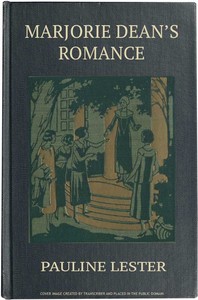
The catalog record for Marjorie Dean's Romance — Background and Themes provides practical reading context through 55,095 words, 4 hr estimated reading time, and 27 detected text sections.
The text analysis averages about 13.1 words per sentence, while the detected sections provide another way to judge how the source is divided.
Project Gutenberg metadata also associates the work with “Bildungsromans,” connecting these edition facts with the source record’s subject description.
Explore this collection
These alternatives are selected using recorded categories and estimated reading time.
About 243 minutes
Historical Psychological Social Fiction
55,766 recorded words. 3 minutes difference from this book's estimate.
View Gutenberg source #45680About 243 minutes
Historical Psychological Social Fiction
55,730 recorded words. 3 minutes difference from this book's estimate.
View Gutenberg source #45776About 228 minutes
Historical Psychological Social Fiction
52,402 recorded words. 12 minutes difference from this book's estimate.
View Gutenberg source #44951Search stored excerpts and compare books → Choose by your preferences →
Choices use stored catalog measurements. Estimates vary with reading speed. A shared category is a catalog label, not a claim that two books have the same argument or literary quality.
Search reads excerpt text stored with this catalog and links to its associated Gutenberg record. The connection is stored in the site database; this tool does not recheck that every excerpt is word-for-word identical to that external record. Excerpt search does not cover every chapter and does not verify historical publication dates.
Catalog snapshot checked: 2026-09-25. Coverage: 95 public books, 95 available source excerpts.
Calculated from edition completeness, EPUB availability, text structure and catalogue metadata. Not a user rating.
Total of 100 points, scaled to a 2.5-5.0 range. Editions with an empty description or a missing EPUB file are not scored.
Public-domain source text
The source text is kept in the dedicated reader, separate from this catalogue record and its commentary.
The novel opens with Marjorie Dean alone in Brooke Hamilton's study, addressing the sun as an 'affectionatious old dear.' This direct, playful voice—talking to sunlight—immediately establishes her character as imaginative and sociable, even in solitude. The entrance of Jeremiah Macy, who speaks from offstage with a respectful yet teasing tone, introduces a key relationship built on banter and nicknames like 'Bean.' Their exchange reveals a comfortable friendship rooted in shared history, as Jeremiah references 'happy bygone campus days.' The scene also hints at Marjorie's current occupation: she is studying a 'time-stained sheet of paper,' later identified as material for a biography she is writing, divided into parts titled 'Inspiration' and 'Realization.'
The opening chapter establishes a distinctive narrative voice through Marjorie's personification of the sun. She calls it 'affectionatious' and scolds it for 'skulk[ing] behind the clouds,' a whimsical tone that persists throughout the excerpts. The setting—Brooke Hamilton's study—is described with sensory detail: 'pale spring afternoon,' 'ashen gray clouds,' and 'radiant light' that 'transfigures' Marjorie's face. This attention to light and atmosphere recurs in later scenes, such as the Easter vacation discussion, where Marjorie's mood is conveyed through her 'frisky delight' and dance. The study itself becomes a space of intellectual work and personal reflection, contrasting with the more social quarters at Hamilton Arms.
Jeremiah Macy serves as both confidante and comic relief. Their dialogue is marked by affectionate teasing: Jeremiah calls Marjorie 'Bean' and accuses her of being 'snippy,' while she responds with mock indignation. This dynamic is consistent across the excerpts. In Chapter XVI, Jeremiah recites a spontaneous jingle—'No Feejee queen compares with Bean'—and Marjorie pats her head, calling her a 'loyal Jeremiah.' Their plans for Easter reveal a mutual commitment: Jeremiah chooses to stay at Hamilton Arms rather than go home, citing loyalty to Marjorie. The friendship is portrayed as a source of stability, with Marjorie noting she has told Jeremiah she is loyal 'seven thousand times, more or less.'
Marjorie's work on a biography—presumably of someone significant, though the subject is not named in the excerpts—provides a frame for her character development. She divides the material into two parts: 'Inspiration' and 'Realization.' This division suggests a thematic arc that may parallel her own experiences. In Chapter I, she is 'very very busy' with the project, and in Chapter XVI, she admits that writing can be frustrating: 'I write all day and then find at evening that I haven't done more than a page of good work.' The biography also influences her decisions, as she notes that leaving campus would 'have broken up my work.' This meta-narrative element invites readers to consider how Marjorie's own story might be shaped by the act of writing another's.
The excerpts span different emotional registers. The opening is lighthearted and playful, with Marjorie's banter with Jeremiah and her personification of the sun. In contrast, the later excerpt from Chapter XVI includes a moment of reflection on Leslie's perspective—a character who has harbored a grudge against Marjorie for 'over four years.' The narrative briefly enters Leslie's thoughts, revealing her struggle to accept Marjorie's kindness. This shift to a more serious, introspective tone suggests that the novel may explore themes of forgiveness and reconciliation. The Easter vacation discussion also introduces a note of earnestness, as Marjorie declares 'Captain first, you know,' indicating her deep loyalty to her mother.
Readers approaching Marjorie Dean's Romance for the first time will find that the excerpts offer a coherent introduction to the protagonist's voice, her central friendships, and her ongoing project. The biography she writes may serve as a mirror for her own growth, while the shifts in tone hint at conflicts to come. Pay attention to how Marjorie's playful language and her interactions with Jeremiah evolve as the story progresses, and consider how the theme of loyalty—to friends, family, and personal goals—shapes the narrative.
There’s something about Marjorie’s quiet diligence—piecing together another’s life story—that lingers. It reminds me of how, in reading Under the White Ensign: A Naval Story of the Great War — Key Ideas to Explore, I found the same patient attention to duty and consequence, though on a vaster, more urgent sea. I think of both books often, like old friends whose worries I still carry. Marjorie Dean feels gentler now.
Answer a few questions and save a private reflection on this device.