About 256 minutes
Patty's Fortune — Reading Companion
Historical Psychological Social Fiction
58,748 recorded words. 0 minutes difference from this book's estimate.
View Gutenberg source #51354
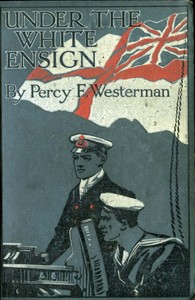
Before opening Under the White Ensign: A Naval Story of the Great War — Key Ideas to Explore, the edition data offers a quick orientation: 58,654 words, 4 hr 16 min estimated reading time, and 8 detected text sections.
The text analysis averages about 16.0 words per sentence, while the detected sections provide another way to judge how the source is divided.
Project Gutenberg metadata also associates the work with “War stories,” connecting these edition facts with the source record’s subject description.
Explore this collection
These alternatives are selected using recorded categories and estimated reading time.
About 256 minutes
Historical Psychological Social Fiction
58,748 recorded words. 0 minutes difference from this book's estimate.
View Gutenberg source #51354About 243 minutes
Historical Psychological Social Fiction
55,766 recorded words. 13 minutes difference from this book's estimate.
View Gutenberg source #45680About 243 minutes
Historical Psychological Social Fiction
55,730 recorded words. 13 minutes difference from this book's estimate.
View Gutenberg source #45776Search stored excerpts and compare books → Choose by your preferences →
Choices use stored catalog measurements. Estimates vary with reading speed. A shared category is a catalog label, not a claim that two books have the same argument or literary quality.
Search reads excerpt text stored with this catalog and links to its associated Gutenberg record. The connection is stored in the site database; this tool does not recheck that every excerpt is word-for-word identical to that external record. Excerpt search does not cover every chapter and does not verify historical publication dates.
Catalog snapshot checked: 2026-09-25. Coverage: 95 public books, 95 available source excerpts.
Calculated from edition completeness, EPUB availability, text structure and catalogue metadata. Not a user rating.
Total of 100 points, scaled to a 2.5-5.0 range. Editions with an empty description or a missing EPUB file are not scored.
Public-domain source text
The source text is kept in the dedicated reader, separate from this catalogue record and its commentary.
The story opens with Sub-lieutenant Webb's blunt complaint, "What a rotten night!"—a line that sets the tone for a narrative built on abrupt transitions between comfort and crisis. From the brightness of his cabin to the blackness of the deck, the text repeatedly contrasts sheltered spaces with violent natural forces. The opening chapter immediately thrusts Webb into a shipwreck, where the sea is described as an "irresistible rush" and a "mass of green sea" that capsizes his boat. This pattern of sudden, overwhelming events recurs throughout the excerpts, with characters frequently caught between the safety of a vessel and the hostility of the elements.
The novel's structure is distinctly episodic, moving rapidly between settings without lingering. The table of contents lists twenty-eight chapters with titles like "Rammed," "Submarined," and "Driven to Destruction," each suggesting a discrete incident. In the excerpts, the action shifts from the deck of the Portchester Castle to a lifeboat, then to a beach under storm, and later to a zariba fortification under threat from the Senussi. These transitions are abrupt: Webb is thrown from the boat into the surf, then wakes under a prickly bush. The narrative does not dwell on travel or downtime; instead, it cuts directly to the next crisis. This episodic quality gives the story a breathless pace, but also means that character development and reflection are minimized in favor of continuous action.
Water is not merely a setting but an active, destructive force. The excerpts repeatedly use phrases like "mass of green sea," "crested breaker," and "mountain of water" to emphasize its power. Wreckage—boats' gear, broken oars, flotsam—appears as both hazard and tool. Webb uses a broken oar blade to anchor himself against the undertow, a detail that highlights the theme of improvisation amid disaster. The sea is also linked to disorientation: Webb loses "count of time and place," and torpor seizes him. Later, on shore, the same men who were struggling in the surf are now digging in sand and building defenses, suggesting a cycle of survival that repeats across different environments. The image of the "broad-leaved prickly bush" that shelters Webb contrasts sharply with the open water, yet both settings demand constant vigilance.
Westerman's prose is economical, favoring short declarative sentences and minimal interiority. The opening line, "What a rotten night!" is typical: characters speak plainly, without embellishment. When Webb is rescued, Dacres's "cheering words of encouragement" are not quoted—the narrative reports them rather than dramatizing them. This restraint extends to descriptions of injury and death: "some whom Webb would never again meet on this earth" is as close as the text comes to elegy. The effect is a matter-of-fact tone that mirrors the stoicism expected of naval officers. Dialogue, when it appears, is functional, conveying orders or warnings. The absence of extended conversation or emotional outbursts keeps the focus on physical action and external events, aligning with the genre's conventions of adventure fiction for young readers.
The excerpts depict a world where the environment itself is an antagonist. The storm at sea is described with relentless physical detail: the undertow, the breakers, the "treacherous shore" that gives way under Webb's hands. On land, the sun beats "fiercely down," and the ground is "almost barren." The men must construct a zariba from prickly scrub, anticipating attack. Even the life-saving gear becomes a liability, trapping men under the capsized boat. Westerman does not romanticize the setting; it is consistently portrayed as indifferent or hostile. This treatment of place as a source of danger rather than backdrop reinforces the story's emphasis on survival skills and resourcefulness. The repeated mention of "sand" and "scrub" in the shore section grounds the narrative in a specific geography—likely the North African coast—but the focus remains on how the characters adapt to its threats.
Readers approaching Under the White Ensign should expect a fast-moving series of disasters and escapes rather than a single sustained plot. The novel rewards attention to small details of equipment and environment—a broken oar, a strip of calico, a zariba—that become crucial to survival. Westerman's style is lean, leaving much unsaid about his characters' inner lives, but the physical world is rendered with precision. For those interested in early twentieth-century adventure fiction or naval operations in World War I, this story offers a period-specific blend of technical detail and relentless action.
There’s something about Webb’s drifting wreckage in Under the White Ensign that lingers—that sense of making do with whatever the sea leaves behind. It reminded me, oddly, of an old favorite, The Motor Boys in Strange Waters; or, Lost in a Floating Forest — Background and Themes, where the boys navigate a tangle of half-submerged trees. Both feel like quiet studies in improvised survival, though one carries a heavier shadow.
Save your reaction, strongest insight, and memorable passage.