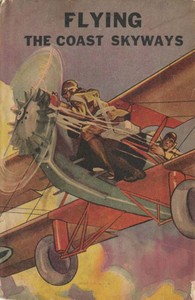
About 243 minutes
Flying the Coast Skyways; Or, Jack Ralston's Swift Patrol — Story, Setting & Ideas
Historical Psychological Social Fiction
55,766 recorded words. 0 minutes difference from this book's estimate.
View Gutenberg source #45680
This digital edition of The Sky Detectives; Or, How Jack Ralston Got His Man — Text and Context is described by source-level measurements including 55,730 words, 4 hr 3 min estimated reading time, and 30 detected text sections.
The text analysis averages about 32.6 words per sentence, while the detected sections provide another way to judge how the source is divided.
Project Gutenberg metadata also associates the work with “Detective and mystery stories,” connecting these edition facts with the source record’s subject description.
Explore this collection
These alternatives are selected using recorded categories and estimated reading time.
About 243 minutes
Historical Psychological Social Fiction
55,766 recorded words. 0 minutes difference from this book's estimate.
View Gutenberg source #45680About 240 minutes
Historical Psychological Social Fiction
55,095 recorded words. 3 minutes difference from this book's estimate.
View Gutenberg source #53440About 256 minutes
Historical Psychological Social Fiction
58,748 recorded words. 13 minutes difference from this book's estimate.
View Gutenberg source #51354Search stored excerpts and compare books → Choose by your preferences →
Choices use stored catalog measurements. Estimates vary with reading speed. A shared category is a catalog label, not a claim that two books have the same argument or literary quality.
Search reads excerpt text stored with this catalog and links to its associated Gutenberg record. The connection is stored in the site database; this tool does not recheck that every excerpt is word-for-word identical to that external record. Excerpt search does not cover every chapter and does not verify historical publication dates.
Catalog snapshot checked: 2026-09-25. Coverage: 95 public books, 95 available source excerpts.
Calculated from edition completeness, EPUB availability, text structure and catalogue metadata. Not a user rating.
Total of 100 points, scaled to a 2.5-5.0 range. Editions with an empty description or a missing EPUB file are not scored.
Public-domain source text
The source text is kept in the dedicated reader, separate from this catalogue record and its commentary.
Ambrose Newcomb's The Sky Detectives opens not with a crime but with a takeoff. Jack Ralston and his pal Perk climb out of a taxi at Candler Flying Field near Atlanta, where a stunt-flying competition provides cover for their departure. The early pages establish a pattern: the story moves through a series of departures and landings, each leg of the flight introducing new terrain and new complications. Newcomb devotes considerable space to the mechanics of flying—schedule times, mail routes, instrument reliance—while also seeding the pursuit plot through casual dialogue. The result is a hybrid: part aviation procedural, part chase narrative, with the sky itself serving as both setting and antagonist.
The book's thirty chapters correspond to stages of a journey, each titled like a flight log: “Ready for the Takeoff,” “Headed South,” “Skirting the Gulf,” “Over Arizona Deserts.” This structure gives the narrative a forward momentum that mirrors the physical act of flying. Newcomb uses each new location—Atlanta, New Orleans, the Gulf coast, Arizona, the Sierra Madre—as a fresh scene for detection and danger. The movement is not random; it follows a logical geographic progression south and west, toward the “tiger's lair” of the final chapters. Within each leg, the author balances cockpit dialogue with external action, so that the reader experiences both the monotony of long flights and the sudden violence of storms or encounters.
Newcomb returns repeatedly to two image clusters: the behavior of weather and the reliance on instruments. Fog is described as “thick as pea-soup”; a storm arrives with a “dazzling flash” and “tremendous burst of thunder”; the moon's “silvery rays” give way to “dense masses of clouds.” These descriptions are not mere atmosphere—they drive the plot, forcing Jack to climb above storms or trust his instruments when ground references vanish. The author emphasizes the pilot's dependence on “faithful instruments” as an “old story to one of his experience,” contrasting Jack's calm competence with Perk's more visceral reactions. This technical grounding gives the adventure a documentary feel, even as the storm sequences become increasingly dramatic.
Gabe “Perk” Perkiser functions as the reader's surrogate, voicing the anxieties and observations that Jack, as the experienced pilot, internalizes. Perk's dialogue is marked by colloquial exclamations—“Ginger pop!”—and a practical concern for comfort, such as fumbling for his oilskin coat when rain threatens. He signals to take over the controls so Jack can also protect himself, a detail that underscores their partnership. Newcomb uses Perk to register the emotional weight of the journey: his heart “jumped up in his throat” during turbulence, and he finds the moonlit gulf a picture that “even appealed to Perk's rugged nature.” Without Perk, the narrative would lack a barometer for tension; with him, the reader experiences the flight as both a technical feat and a personal ordeal.
Nearly all the action in the excerpts takes place in or around the aircraft, with the open cockpit serving as a confined stage. The physical details—helmets, goggles, oilskin coats, the “tattoo” of rain on the fuselage—create a sensory environment that is both claustrophobic and exposed. When the storm hits, the ship becomes a “mere chip tossed about,” and the flyers cling to it as the wind “whistled around their ears.” Newcomb does not describe the interior of the plane in any detail; instead, he focuses on the interface between the crew and the elements. This choice keeps the narrative immediate and visceral, while also reinforcing the theme of human skill pitted against natural force. The cockpit is not just a setting but a crucible in which the characters' competence is tested.
Readers approaching The Sky Detectives should expect a narrative that moves as steadily as a flight plan, with each chapter advancing both the geographic journey and the manhunt. Newcomb's prose favors concrete detail over psychological depth, and the story's pleasures lie in its period aviation lore and the rhythmic alternation of calm and crisis. The book rewards attention to the small technical choices—when to climb, when to trust instruments, how to read the sky—that define Jack Ralston's craft.
I keep thinking about that moment in The Sky Detectives when Jack scans the endless clouds for a speck that might be his quarry—how solitude sharpens a search. It reminded me of reading A Little Girl in Old Pittsburg — Themes and Context, where a child watches a river, hoping for a familiar face among strangers. Both felt like waiting for something that only patience reveals. That quiet ache stayed with me.
Your answers remain private and are stored only in this browser.