1

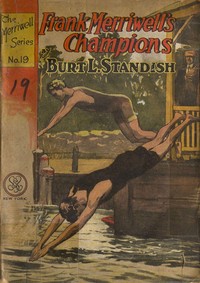
Frank Merriwell's Champions; Or, All in the Game — Inside the Classic
(0 User reviews)
459
Project Gutenberg
2013
Not confirmed
Gambling -- Juvenile fiction; Sports stories; Boxing stories; Merriwell, Frank (Fictitious character) -- Juvenile fiction
Readers of public-domain and historical texts
Project Gutenberg digital edition
en
Edition facts
Words
79,130
Reading time
345 min
Text sections
40
The source record for Frank Merriwell's Champions; Or, All in the Game — Inside the Classic measures this digital text at 79,130 words, 5 hr 45 min estimated reading time, and 40 detected text sections.
The text analysis averages about 14.4 words per sentence, while the detected sections provide another way to judge how the source is divided.
Project Gutenberg metadata also associates the work with “Gambling -- Juvenile fiction,” connecting these edition facts with the source record’s subject description.
Source:
Project Gutenberg record #42049
In this installment of the Merriwell series, Frank and his Yale friends navigate bicycle tours, horse-riding lessons, and athletic competitions in Virginia, with a focus on Frank's observational skills and his moral stance against cruelty to animals.
Editorial Edition Score
4.8/5
★★★★★
★★★★★
Calculated from edition completeness, EPUB availability, text structure and catalogue metadata. Not a user rating.
How this score is calculated
- Description quality20 pts
- Title & short description10 pts
- Source metadata20 pts
- Text length15 pts
- Chapters / structure15 pts
- EPUB file integrity20 pts
Total of 100 points, scaled to a 2.5-5.0 range. Editions with an empty description or a missing EPUB file are not scored.
Edition quality
Read the Text
you say, fellows?” questioned Merriwell, turning toward his companions.
“Av it’s thim chumps upon the hill!” exclaimed Barney Mulloy.
“I think I’d like that, by thutter!” declared Ephraim Gallup.
“You pets my poots, dot voult pe a bicnic!” asserted Hans Dunnerwust, the jolly-looking Dutch boy.
The others assented, each after his own peculiar manner.
“When do you want us to come down?” asked Frank.
“Right now, this minute, if you will!” cried Colson’s companion, who had hitherto maintained a grave silence. “It’s lonesome as a graveyard down there. And you’ll want to do some practicing! Can you handle the bow and arrow?”
Philip Tetlow’s face lighted up with such fine enthusiasm, and his delight was so manifest, that Frank could hardly restrain a laugh.
“We must see the landlord of the hotel first,” said Merriwell, “for we have already registered here, and he may interpose objections to our summary leave-taking. But you may count on it that we will be with you without much delay.”
Two hours later, Merriwell and the entire Yale Combine were snugly installed in the cottages of the Lake Lily Athletic Club.
“I’m afraid I’m going to have another one of those infernal chills,” grumbled Browning, as, with a blanket drawn over him, he reclined in a hammock and looked across the water toward the village. “I guess I shall never get that Arkansas malaria out of my system, though I’ve taken enough quinine to start a drug store.”
Rattleton cast a look of mock anxiety at the rather flimsy walls.
“I say, Browning, when you get to shaking right good, as you did that other time, you’ll have your cot put out under the trees, won’t you? Just for the safety of the rest of us, you know.”
“No, I won’t!” Browning growled. “If I bring the house down on myself, like old Samson, it will delight me to bury all the rest of you in the ruins.”
“Say, fellows,” cried the irrepressible Rattleton, “why is Browning like a member of a certain well-known religious organization?”
“Oh, go chase yourself out of here!” begged Bruce. “I’m already sick, and your weak jokes make me sicker.”
“It’s because he’s a Shaker.”
Browning groaned and turned his face toward the wall.
“Won’t some one kindly kill that idiot for me?” he pleaded.
Frank Merriwell came into the room, holding a handsome lancewood bow and a sheaf of arrows.
“If we are going to meet Ward Hammond and his Blue Mountain boys day after to-morrow,” he said, surveying the lounging group, “it strikes me that it would be well for the new members of Lake Lily Athletic Club to get in a little archery practice.”
To this there was a general assent, and the entire party prepared to leave the room, with the exception of Bruce Browning, who shivered and drew the blanket closer about him as they got up to go.
Out by the lake there was a level stretch of greensward. Here a target had been set up, and the members of the club had practiced at archery.
Both the new and the old members of the Lake Lily Athletic Club practiced with the bow so faithfully in the limited time given them that when they climbed to the archery ground on the wooded crest of Blue Mountain they felt that they would be able to give Ward Hammond and his friends a hard contest, if nothing more, though Hammond had been heard publicly to declare that the Lilywhites’ new members would add nothing to the strength of the club.
The spot was an ideal one, and commanded a view of the lake and the town. A glade, covered with short grass, opened on the side toward the village, being flanked by wooded slopes. Near at hand were the cottages of the Blue Mountain Club. They were handsomer and more expensive than those of the other club, but not more comfortable. Across one corner of the glade, and dipping down into the dark woods, ran the path on which Merriwell’s bicycle had collided with and crushed the violin.
Ward Hammond and his companions were already on the ground, and Hammond was looking at his watch as Merriwell’s party came up.
“I didn’t know but you fellows had backed out,” he declared, with a sneer, snapping the gold case together and dropping the watch into his pocket.
Jack Diamond flushed and pulled out his own timepiece.
“We’ve ten minutes to spare, if my watch is right!” he asserted.
“Of course your watch is right!” was the suggestive retort.
The opening scene of Frank Merriwell's Champions announces its central tension immediately: a bicycle collides with a music box in a mountain path, producing a “snapping, musical sound” that nearly throws Frank over the handlebars. The accident is both literal and symbolic—the collision of modern machinery (the bicycle) with a fragile object of leisure. Frank’s first act is to dismount and investigate, not to complain. This sets the pattern for a book in which physical mishaps, athletic contests, and moral judgments are closely intertwined.
The narrative voice is brisk and catalog-like, introducing the multi-ethnic crew of Yale chums in a single breath: “fat and lazy Bruce Browning; the gallant Virginian, Jack Diamond; merry-hearted Harry Rattleton; the Yankee youth, Ephraim Gallup; the Dutch boy, Hans Dunnerwust; the lad with Irish blood…Barney Mulloy, and Toots, the colored boy.” The list itself is a miniature of the book’s method—rapid, inclusive, and slightly stereotyped.
The Horse and the Rider
In Chapter XIX, Frank delivers a sustained lecture on horsemanship after witnessing a rider lash his horse and saw at the reins. The passage is remarkable for its technical specificity: Frank explains that “the mouth of a horse, until it is spoiled by bad usage, is a very delicate thing,” and contrasts the “heavy hand” of a bungler with the “light hand” of a skilled jockey. He notes that women often have lighter hands than men, and that a good rider “keeps his back straight, keeps his elbows and hands down, and varies the force on the reins only for the purpose of controlling his horse.”
Barney’s response—wonder at how Frank “knows so much about everything”—is the book’s own commentary on its hero. Frank’s knowledge is presented as the fruit of deliberate practice: “I made up my mind that I couldn’t know too much, and I resolved to find out all about everything that came beneath my notice.” The scene thus functions as both a practical lesson and a character statement, linking physical skill to moral discipline.
Voices in the Crew
The dialogue of Frank’s companions is heavily marked by dialect and catchphrases. Barney Mulloy speaks with a stage-Irish brogue (“May th’ Ould Nick floy away wid him!”), while Hans Dunnerwust is described as “the Dutch boy” and Ephraim Gallup as “the Yankee youth.” These tags are not merely decorative; they create a chorus of distinct voices that comment on Frank’s actions. When Barney asks, “How do ye foind it all out, Frankie?” the question is both naive and admiring, reinforcing Frank’s role as the knowledgeable center.
The catalog of the bicycle party in Chapter I—with its repeated “the…boy” constructions—reads like a roll call of types. Yet the book does not treat these types as interchangeable. Bruce Browning is “fat and lazy,” Jack Diamond “gallant,” Harry Rattleton “merry-hearted.” Each label carries a hint of function: the lazy one may need prodding, the gallant one may defend honor, the merry one may lighten a tense moment. The narrative economy is high: a single sentence introduces the whole ensemble and their likely roles.
The Structure of Contests
The chapter titles reveal a book built around discrete physical challenges: “Shooting at the Disk of Gold,” “A Boxing Match,” “The Eight-Oar Shell,” “The Race,” “Choice of Ponies,” “The First Go,” “The Hunt.” Each title promises a set piece of competition, and the narrative delivers them in sequence. The book’s subtitle, “All in the Game,” suggests that these contests are not merely tests of skill but expressions of a larger code—sportsmanship, fairness, and self-improvement.
But the contests are also opportunities for moral drama. In the opening chapter, Frank’s bicycle accident leads to a confrontation with a horseman who “lashes” his mount. Frank’s judgment is swift: “What he really needs is a sound thrashing.” The line between physical contest and moral correction is thin. Frank does not seek a quarrel, but he does not shrink from one either. The book’s rhythm—accident, lecture, contest, judgment—is consistent across the excerpts, suggesting a pattern that likely holds throughout the full text.
Readers approaching Frank Merriwell's Champions should pay attention to the interplay between action and instruction. Frank’s lectures on horsemanship, bicycle handling, or boxing technique are not digressions; they are the book’s way of demonstrating that skill and virtue are learned, not innate. The dialect voices of his friends provide both comic relief and a foil for Frank’s earnestness. The episodic structure—each chapter a new contest or adventure—makes the book suitable for serial reading, but the consistent moral thread rewards attention to detail.
Rereading Frank Merriwell's Champions, I paused at his quiet horror over a mistreated horse—that unshowy decency that always felt more real than his athletic feats. It reminded me of another world where gentleness hides inside ambition. That’s the echo I found in Helen Ford — Text and Context, where kindness isn’t preached, just breathed between the lines.
There are no reviews for this eBook.
There are no comments for this eBook.
Reader reflection
Before you leave, reflect on the book
Use these questions to collect your thoughts before moving on.
Your progress
0
/
10
2
What was your overall reaction to the book?
3
Would you pass this book on to a friend?
4
How easy was the book to follow?
5
How clearly were the main ideas presented?
6
Could you apply anything you learned?
7
How personally connected did you feel to the book?
8
How strongly did the book affect you emotionally?
9
In one sentence, what did you learn?
10