About 91 minutes
Two in a Zoo — Reading Notes
Young Readers Enchanted Adventures
20,840 recorded words. 9 minutes difference from this book's estimate.
View Gutenberg source #46159
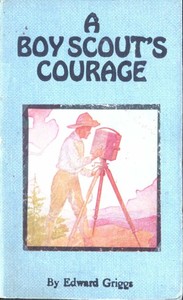
A Boy Scout's Courage — Text and Context can be approached with a clearer sense of reading commitment from its source measurements: 22,951 words, 1 hr 40 min estimated reading time, and 14 detected text sections.
The text analysis averages about 13.4 words per sentence, while the detected sections provide another way to judge how the source is divided.
Project Gutenberg metadata also associates the work with “Spy stories,” connecting these edition facts with the source record’s subject description.
Explore this collection
These alternatives are selected using recorded categories and estimated reading time.
About 91 minutes
Young Readers Enchanted Adventures
20,840 recorded words. 9 minutes difference from this book's estimate.
View Gutenberg source #46159About 134 minutes
Young Readers Enchanted Adventures
30,815 recorded words. 34 minutes difference from this book's estimate.
View Gutenberg source #46146About 136 minutes
Young Readers Enchanted Adventures
31,051 recorded words. 36 minutes difference from this book's estimate.
View Gutenberg source #45232Search stored excerpts and compare books → Choose by your preferences →
Choices use stored catalog measurements. Estimates vary with reading speed. A shared category is a catalog label, not a claim that two books have the same argument or literary quality.
Search reads excerpt text stored with this catalog and links to its associated Gutenberg record. The connection is stored in the site database; this tool does not recheck that every excerpt is word-for-word identical to that external record. Excerpt search does not cover every chapter and does not verify historical publication dates.
Catalog snapshot checked: 2026-09-25. Coverage: 95 public books, 95 available source excerpts.
Calculated from edition completeness, EPUB availability, text structure and catalogue metadata. Not a user rating.
Total of 100 points, scaled to a 2.5-5.0 range. Editions with an empty description or a missing EPUB file are not scored.
Public-domain source text
The source text is kept in the dedicated reader, separate from this catalogue record and its commentary.
The opening chapter of A Boy Scout's Courage plunges the reader into a breathless sequence of questions—"Was it little more than a week…?"—that compress time and heighten urgency. Harry Fleming, an American Scout in London, recalls a series of events in a single, anxious paragraph: his parents recalled to the States, a mission with chum Dick Mercer, the discovery of secret heliographs signaling across the North Sea. The prose mirrors his racing mind, piling up clauses without pause.
Griggs then shifts to immediate sensory detail: the gleam of flashlights, the pain of a wrenched ankle caught in a trap, the sound of searchers advancing. The voice is direct and concrete, avoiding sentimentality. Harry's fear is physical—"excruciating" pain—but his resolve is stated plainly: "he kept silence resolutely." This opening establishes a pattern of external action filtered through internal tension, a hallmark of the authorial choices in the excerpts.
The first chapter opens with a string of rhetorical questions—"Was it little more than a week…? Was it just a week since…? Was it just two days since…?"—that serve not as genuine inquiries but as a compressed summary of backstory. This technique, repeated in the excerpts, creates a sense of breathlessness and disorientation. The reader is thrust into the middle of action without exposition. Griggs uses this device sparingly: only at chapter openings or moments of high stress. It mimics a character's attempt to order chaotic events, and it signals that the narrative prioritizes immediate tension over chronological clarity. The questions also establish Harry's voice—anxious, earnest, and focused on the recent past—without resorting to lengthy flashbacks.
Griggs's word choices consistently emphasize physical and emotional strain. Verbs like "pinned," "wrenched," "excruciating," and "gritted his teeth" ground the story in bodily sensation. Dialogue is clipped and functional: "You keep away from me!" and "Forward–march!" convey authority and conflict without elaboration. The narrator rarely editorializes; instead, the prose reports actions and sensations. When Harry reflects on modern warfare, the language becomes more abstract—"swift, stabbing raids," "ugly thing"—but still avoids melodrama. This restraint is notable for a juvenile adventure: the author trusts the reader to infer emotion from situation. The effect is a lean, propulsive style that keeps the focus on what happens next.
The excerpts use setting not as backdrop but as an active element. The "mysterious estate outside the sleepy English village" is guarded by a reclusive American; its grounds conceal traps, heliographs, and spies. Griggs describes the environment through sensory fragments: "the gleam of their flashlights," "a faint drizzle," "a fine film of mud." These details anchor the action in a tangible world. London appears only as a destination—"the truck was well into London now"—but the city remains vague, defined by movement rather than place. The contrast between the rural estate (secret, dangerous) and the urban center (bureaucratic, with arrests) reinforces the theme of hidden threats. The setting is never picturesque; it is always functional, a space to be navigated or escaped.
The excerpts culminate in Harry's arrest for espionage—a charge that the reader knows is false. Griggs handles this irony through voice: the officer speaks in formal, impersonal phrases ("You're under arrest… on a charge of espionage"), while Harry's responses are fragmented and emotional ("What–what's this?" "I must be allowed to see Colonel Throckmorton at once!"). The contrast underscores the gap between institutional authority and individual truth. The narrative never confirms Harry's innocence outright; it relies on the reader's trust in the protagonist's perspective. This technique, common in adventure fiction, here gains specificity from the clipped dialogue and the absence of authorial commentary. The reader is left to judge based on action and tone alone.
Readers approaching A Boy Scout's Courage should attend to how Griggs builds suspense through repetition and compression. The rapid questions, the physical details, and the terse exchanges all serve to keep the plot moving without sacrificing texture. This is a story that trusts its audience to keep up—and rewards close attention to the way language shapes tension.
That rainy afternoon, Harry Fleming’s twisted ankle and the muddy, claustrophobic tension of his trap stayed with me long after the heliograph signals faded. I found myself thinking about quiet endurance—how one small misstep reshapes everything. Later, reaching for something softer, I picked up Mildred at Home: With Something About Her Relatives and Friends. A sequel to Mildred's married life. — Edition Insights, and the warmth of domestic hammocks felt like a deliberate counterweight to that wartime drizzle.
Build a private reading journal entry for this title.