About 298 minutes
Frank Merriwell's Athletes; Or, The Boys Who Won — Reading Companion
Young Readers Enchanted Adventures
68,435 recorded words. 5 minutes difference from this book's estimate.
View Gutenberg source #41996
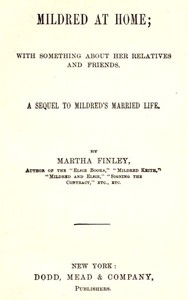
For Mildred at Home: With Something About Her Relatives and Friends. A sequel to Mildred's married life. — Edition Insights, the stored edition analysis reports 67,336 words, 4 hr 53 min estimated reading time, and 20 detected text sections.
The text analysis averages about 19.8 words per sentence, while the detected sections provide another way to judge how the source is divided.
Project Gutenberg metadata also associates the work with “Christian life -- Juvenile fiction,” connecting these edition facts with the source record’s subject description.
Explore this collection
These alternatives are selected using recorded categories and estimated reading time.
About 298 minutes
Young Readers Enchanted Adventures
68,435 recorded words. 5 minutes difference from this book's estimate.
View Gutenberg source #41996About 283 minutes
Young Readers Enchanted Adventures
64,899 recorded words. 10 minutes difference from this book's estimate.
View Gutenberg source #41964About 281 minutes
Young Readers Enchanted Adventures
64,557 recorded words. 12 minutes difference from this book's estimate.
View Gutenberg source #38558Search stored excerpts and compare books → Choose by your preferences →
Choices use stored catalog measurements. Estimates vary with reading speed. A shared category is a catalog label, not a claim that two books have the same argument or literary quality.
Search reads excerpt text stored with this catalog and links to its associated Gutenberg record. The connection is stored in the site database; this tool does not recheck that every excerpt is word-for-word identical to that external record. Excerpt search does not cover every chapter and does not verify historical publication dates.
Catalog snapshot checked: 2026-09-25. Coverage: 95 public books, 95 available source excerpts.
Calculated from edition completeness, EPUB availability, text structure and catalogue metadata. Not a user rating.
Total of 100 points, scaled to a 2.5-5.0 range. Editions with an empty description or a missing EPUB file are not scored.
Public-domain source text
The source text is kept in the dedicated reader, separate from this catalogue record and its commentary.
Martha Finley opens Mildred at Home with a quiet domestic scene: young Elsie talks with her mammy Chloe about wearing white with blue ribbons, missing Annis, and the comfort of having her father. The dialogue is rendered in dialect—Chloe says “co'se you is” and “tank de Lord”—while Elsie speaks in standard English, marking a clear social and generational boundary. This intimate exchange, threaded with biblical allusion (“A word spoken in due season”), establishes a voice that is both sentimental and precise.
Yet the narrative soon pivots to a very different register. A prairie crossing scene shifts into a sudden Indian attack, with terse action verbs (“caught,” “threw,” “pulled”) and clipped dialogue (“Indians! Indians!”). The pacing accelerates from leisurely description to sharp, fragmented urgency, then slows again for aftermath and prayer. Finley uses these tonal shifts to underscore the precariousness of life in the Keith family's world.
The opening chapter relies heavily on dialect to distinguish Chloe, the mammy, from the white characters. Chloe says “I'se got my own darlin' chile lef'” and “'Pears like ole times come back,” while Elsie responds in unmarked English: “Oh, don't these rooms seem lonely, mammy?” This linguistic divide is consistent with period conventions, but Finley gives Chloe reflective lines that carry emotional weight—she hopes Elsie will always think of her as she does now. The dialogue also reveals the household's recent losses: Annis is gone, and the family has returned to a quieter life after the father's remarriage. The voice here is measured, with long sentences and gentle repetition, creating a rhythm of comfort and memory.
The prairie journey section contrasts sharply with the domestic opening. Finley builds suspense through incremental detail: provisions are low, game is scarce, and the men ride off in search of food. The prose is unhurried, noting the “boundless rolling prairie” and the slow-moving wagon train. Then the pace fractures. The cry “Indians! Indians!” triggers a flurry of short actions: Don catches up two little girls, throws them into the wagon, pulls out a revolver. The fight is described in a single compressed paragraph, with the Indians driven off “carrying their killed and wounded with them.” Afterward, the tempo slows again for Don's groaning question, “Rupert? my brother—where is he?” and the consoling voices of the women. This alternation of calm and crisis is a structural pattern in the excerpts.
Religious language permeates both domestic and crisis scenes. The chapter epigraph is Proverbs 15:23, and characters frequently invoke providence. After Rupert's apparent death, a woman says, “he's gone to a better place; we all know that; nobody could be with him a day and not see that he was a real Christian.” Others chime in: “That's so.” “True enough.” The responses are almost choral, reinforcing a communal faith that is presented as unshakeable. Yet the same characters also express raw grief—Don hides his face and groans. Finley does not resolve the tension between doctrinal comfort and human pain; instead, she lets both stand. The narrative voice treats piety as a natural, almost automatic response, woven into the fabric of daily speech and crisis alike.
Readers will find that Mildred at Home rewards attention to its shifts in register—from the intimate, dialect-laced conversations of the household to the stark, rapid-fire action of the prairie. Finley's prose is most effective when it lets these contrasts speak for themselves, without editorializing. The excerpts suggest a book that moves between two worlds: the sheltered home and the dangerous frontier, each defined by its own tempo and vocabulary. Pay particular notice to how Finley handles the aftermath of violence; the quiet moments after the attack may reveal as much about her characters as the attack itself.
I have often thought Mildred at Home knows the ache of family even amid prairie danger, and how that ache turns toward quiet faith. Beside it sits Sweet Content — Themes and Context, a gentler neighbor, whispering that home lives in a patient heart. They share a hush, a staying power.
Your answers remain private and are stored only in this browser.