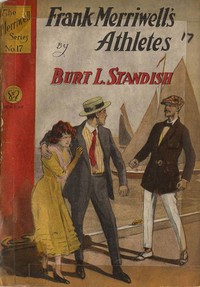
Frank Merriwell's Athletes; Or, The Boys Who Won — Reading Companion

(0 User reviews)   378
Standish, Burt L., 1866-1945 Project Gutenberg 2013 Not confirmed
College students -- Juvenile fiction; West (U.S.) -- Juvenile fiction; Sports stories; Merriwell, Frank (Fictitious character) -- Juvenile fiction Readers of public-domain and historical texts
Project Gutenberg digital edition en

Edition facts

Words 68,435
Reading time 298 min
Text sections 39

The source record for Frank Merriwell's Athletes; Or, The Boys Who Won — Reading Companion measures this digital text at 68,435 words, 4 hr 58 min estimated reading time, and 39 detected text sections.

The text analysis averages about 13.3 words per sentence, while the detected sections provide another way to judge how the source is divided.

Project Gutenberg metadata also associates the work with “College students -- Juvenile fiction,” connecting these edition facts with the source record’s subject description.

An editorial note examining Burt L. Standish's diction, dialogue, and descriptive choices in this Frank Merriwell adventure, where a Chinese theatre opening and a train-stop rescue showcase the author's use of regional speech, tense action, and moral framing.
Share
Editorial Edition Score 4.8/5

Calculated from edition completeness, EPUB availability, text structure and catalogue metadata. Not a user rating.

How this score is calculated
  • Description quality20 pts
  • Title & short description10 pts
  • Source metadata20 pts
  • Text length15 pts
  • Chapters / structure15 pts
  • EPUB file integrity20 pts

Total of 100 points, scaled to a 2.5-5.0 range. Editions with an empty description or a missing EPUB file are not scored.

Edition quality

Read the Text

posed of Frank Merriwell, Harry Rattleton, a former roommate at Yale; Jack Diamond, from Virginia; Bruce Browning, fat, lazy and good-natured; and Toots, a colored boy from the Merriwell homestead.

On reaching California, Frank had fallen in with Bart Hodge, a schoolmate of years gone by, when Frank had attended Fardale Military Academy. Bart had been in serious trouble, and it was Frank who helped him out of it. For some time Hodge had found it best to “keep shady,” and his troubles were not yet a thing of the past.

As the boys walked farther into the entrance of the Chinese theatre, a clanging medley of the most horrible sounds came up from the passage that lay at the foot of a steep flight of stairs.

Frank Merriwell laughed.

“That is music, old fellow!” he said.

Then came another burst of sounds, more horrible than the first, if possible. There was a banging of brass, a clanging of gongs, a roaring of drums, and a wild shrieking and wailing as of ten thousand fiddles cut of tune.

Jack jabbed his fingers into his ears and actually turned pale.

“Music!” he gasped—“that music? That is enough to drive any man crazy! It is the most frightful thing I ever heard. Music! You are joking, Merriwell!”

“Not a bit of it,” declared Frank. “Aren’t we on our way to witness a play in a Chinese theatre?”

“Well, I supposed so, but it strikes me now that this is one of your jokes. You have put up a job on me. You are trying to horse me.”

“Nothing of the sort, my dear boy.”

Jack still continued suspicious.

“Who ever heard of such a way of getting into a theatre?” he exclaimed. “We entered a narrow door in an old building, came through a long, dark passage, climbed stairs, descended stairs, turned, twisted, climbed more stairs, turned again, and now here we are with another flight of stairs before us. A fine way of getting into a theatre!”

“That is the way the Chinese do the trick. Eh, John?”

The Chinaman who had been acting as their guide, and who stood on the first stair, waiting for them to follow him downward, nodded his head, saying:

“Allee samee legler way.”

“It may be the regular way,” admitted Jack; “but I doubt if I could find my way out of here alone. This would be a fine place to run an enemy into if one wished to murder him secretly. There would be little danger that the police would ever find out anything about it.”

Frank made a signal to the guide, and then the trio slowly descended the stairs, which were dimly lighted by paper-shaded lamps.

At the foot of the stairs the boys passed a door that stood open, enabling them to look into a room that was filled with bunks, upon many of which lay Chinamen who were sleeping or smoking opium. The powerful odor of “dope” that came from that room was sickening.

Then they came to an ordinary step-ladder that led downward again.

Jack halted in dismay.

“Why,” he said, “we must be underground now! Where are we going?”

“To the theatre, dear boy. Hear the music.”

“Why will you persist in calling it that? It seems that those sounds come from the infernal regions, and this passage must lead down to the old fellow’s reception-room.”

“Glit to theatal plitty soon,” assured the guide.

Down the ladder they went, and then, at an open door, paid an admission fee, after which they entered a room that was packed with human beings and was not at all well ventilated.

The room had a low ceiling, from which Chinese lanterns were suspended, shedding a soft light over the scene, which was so strange that it actually seemed weird to the American visitors.

At either side of the theatre was a space railed off and raised somewhat above the level of the general floor. This was reserved for women, and was well filled. In the pit sat a closely packed throng of men, all with hats upon their heads.

There were a great number of Caucasian visitors, drawn to the place by curiosity.

The stage was on a level with the raised portion reserved for women, and it was filled with actors, many of whom were richly dressed in oriental robes.

Instead of sitting in front of the stage, like an American orchestra, the musicians were on the stage.

As for scenery, there was none to speak of, save a few movable screens. It was not thought necessary to attempt to please the eye further than in the matter of costumes.

The novel opens not on a playing field but in a Chinese theatre in San Francisco, where Frank Merriwell and his friends are assailed by a “clanging medley of the most horrible” sounds. Standish immediately establishes a contrast between the Yale boys’ civilized sensibilities and the exotic, chaotic setting. The dialogue is brisk and colloquial—Jack Diamond’s “Say, boys, just listen to that racket!” sets a tone of shared adventure. The author’s descriptive choices, such as “narrow and gloomy passages,” create a sense of otherness that will recur when the group later travels to the Southwest.

Dialogue as Character Marker

Standish uses dialogue to distinguish his cast quickly. Harry Rattleton’s exclamation “It is certainly awful” and Bruce Browning’s “It is enough to drive one crazy” reveal their personalities—Rattleton more excitable, Browning languid. Frank’s own speech is measured and polite, even when confronting danger. When he intervenes to stop Dan Carver from shooting a drunken Indian, Frank says, “I saved you from committing murder, sir,” and later appeals to Carver as “a gentleman.” This contrast between Frank’s controlled language and Carver’s terse, threatening replies—“My dear young man, do you know it is very dangerous to chip into a game like that?”—underscores the moral divide. Carver’s dialogue is clipped and sardonic, while Frank’s is reasoned and courteous.

Descriptive Economy in Action Scenes

Standish favors short, punchy sentences during moments of crisis. When Inza is seized, the narrative shifts to rapid-fire action: “With a pantherlike bound, Merry sprang to the rescue.” The simile is simple but effective. The rescue itself is described in a single sentence: “It was all over in a second.” Standish then slows the pace to focus on the standoff with Carver, using precise details like “a long-barreled revolver” and “the bullet flattened against the face of the lava cliff.” These concrete images ground the scene in a specific, rugged landscape. The author avoids lengthy introspection, letting physical actions and objects carry the tension.

Regional Speech and Setting

Standish peppers the narrative with regional markers. The station agent is a “beardless youth” who “showed his importance,” and the loungers are “Mexicans and Indians.” The town itself is reduced to “a single adobe building” serving as post office, hotel, and store. The author’s word choice—“the Celestial portion of San Francisco,” “the lonely monotony of the place”—reflects a period perspective that treats non-white settings as exotic or empty. Carver’s speech carries a Western cadence: “I am ashamed to shoot you, but I may forget myself.” This blend of formal threat and colloquial phrasing gives Carver a distinctive voice, marking him as a “Western sport and ‘bad man.’”

Moral Framing Through Authorial Commentary

Standish occasionally inserts direct commentary to guide reader judgment. When Carver is introduced, the narrator states flatly: “It was said that, when aroused, he was more dangerous than a hundred rattlesnakes.” This hyperbolic comparison leaves no doubt about Carver’s menace. Similarly, Frank’s internal reaction—“Never had Frank seen a more dangerous look on the face of a living man”—reinforces the stakes. The author also uses Frank’s dialogue to articulate the moral code: “as a gentleman, I ask you not to do any shooting here in the presence of these ladies.” Standish thus aligns Frank with chivalric ideals, while Carver’s grudging compliance—“Oh, if you put it that way”—shows a grudging respect for that code.

Readers attentive to Standish’s craft will notice how he balances rapid action with character-revealing dialogue. The novel’s episodic structure—from San Francisco to a New Mexico train stop—allows the author to vary setting and threat. The excerpts suggest that Frank’s moral authority is established less through physical prowess than through his calm, courteous speech. This editorial note encourages observation of how Standish uses language to build a hero who wins not just with his fists but with his words.

Reading the editorial notes on Frank Merriwell's Athletes, I lingered on how Standish captures voices mid-gesture, the theatre lights and hurried rescue both framed by a quiet moral pulse. It put me in mind of a different kind of restraint, the layered silences in Stories of a Governess — Text and Context, where every spoken line seems to carry an unspoken afterthought. Odd, how two such different worlds can share that same inward hush.

There are no reviews for this eBook.

0
0 out of 5 (0 User reviews )

Add a Review

Your Rating *
There are no comments for this eBook.

Reader reflection

What was your reading experience?

Capture what you thought, learned, and would like to remember.

Your progress 0 / 10
1

Which reading stage best describes you?

2

Did this book hold your interest?

3

Would you recommend this book to another reader?

4

Did the language feel accessible?

Related eBooks