About 100 minutes
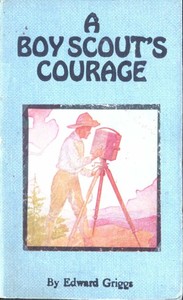
A Boy Scout's Courage — Text and Context
Young Readers Enchanted Adventures
22,951 recorded words. 9 minutes difference from this book's estimate.
View Gutenberg source #40015
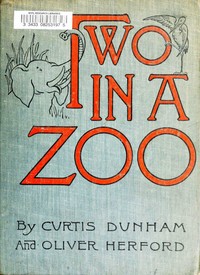
The catalog record for Two in a Zoo — Reading Notes provides practical reading context through 20,840 words, 1 hr 31 min estimated reading time, and 3 detected text sections.
The text analysis averages about 17.1 words per sentence, while the detected sections provide another way to judge how the source is divided.
Project Gutenberg metadata also associates the work with “Animals -- Juvenile fiction,” connecting these edition facts with the source record’s subject description.
Explore this collection
These alternatives are selected using recorded categories and estimated reading time.
About 100 minutes
Young Readers Enchanted Adventures
22,951 recorded words. 9 minutes difference from this book's estimate.
View Gutenberg source #40015About 61 minutes
Young Readers Enchanted Adventures
13,805 recorded words. 30 minutes difference from this book's estimate.
View Gutenberg source #42920About 134 minutes
Young Readers Enchanted Adventures
30,815 recorded words. 43 minutes difference from this book's estimate.
View Gutenberg source #46146Search stored excerpts and compare books → Choose by your preferences →
Choices use stored catalog measurements. Estimates vary with reading speed. A shared category is a catalog label, not a claim that two books have the same argument or literary quality.
Search reads excerpt text stored with this catalog and links to its associated Gutenberg record. The connection is stored in the site database; this tool does not recheck that every excerpt is word-for-word identical to that external record. Excerpt search does not cover every chapter and does not verify historical publication dates.
Catalog snapshot checked: 2026-09-25. Coverage: 95 public books, 95 available source excerpts.
Calculated from edition completeness, EPUB availability, text structure and catalogue metadata. Not a user rating.
Total of 100 points, scaled to a 2.5-5.0 range. Editions with an empty description or a missing EPUB file are not scored.
Public-domain source text
The source text is kept in the dedicated reader, separate from this catalogue record and its commentary.
The story opens not with a human voice but with the Song of the Captive Elephant, a poem that contrasts the jungle's freedom with the zoo's confinement. Immediately afterward, the narrative settles on Mahmoud, an elephant whose iron band and chain mirror the metal straps on a boy's crippled leg. The clanking sound of that leg—described as a 'familiar tinkling'—draws Mahmoud's attention before the boy even appears. This pairing of animal and child through shared physical restraint and aural cues establishes the book's central method: linking characters by concrete, sensory details rather than explicit commentary.
The text uses a small set of sounds and motions to bind its characters. The clanking of the boy's leg irons is the first link to Mahmoud's chain. Later, the surgeon's muttered 'hum, ha' becomes a refrain: each utterance makes Mahmoud flap his ears and step closer, until the elephant recognizes the man who once operated on his trunk. The surgeon himself uses 'hum, ha' as a private thinking tool, and the narrator explicitly notes that Toots 'now saw that when the Princess' father said "hum, ha," he was talking to himself.' This verbal tic recurs at every turn—during the examination of Toots's leg, the inspection of the elephant's scars, and the final offer of surgery. The repetition turns a mannerism into a structural device, linking human and animal recognition across species.
The narrative moves through the zoo by following characters from one enclosure to another, but the transitions are often abrupt. The Elephant House is the primary setting, yet the Princess 'suddenly' appears from the shrubbery, dragging her father. Later, a rabbit 'stuck one of its ears straight up' in a scene that shifts focus without warning. These jumps mirror the way children move through a zoo—drawn by a sound or a sight, not by a plotted route. The book does not explain these shifts; it simply records them, leaving the reader to infer the spatial logic. The effect is a story that feels less like a guided tour and more like a series of overheard moments, each enclosure offering a new conversation that builds on the last.
Mahmoud's body carries the story's history. His trunk bears scars from a skin-graft operation, and the surgeon recognizes his own work by those marks. The elephant's memory is tested when he 'began fondling the large man with the tip of his trunk' after hearing the familiar 'hum, ha.' The text does not attribute human-like thought to Mahmoud; instead, it presents his behavior as a physical response to a remembered sound. The scars are described in clinical detail—'the scars on the old elephant's proboscis'—and the surgeon's pride in the operation ('the first case of elephant skin-grafting ever attempted') ties the animal's past to the boy's future. Toots's leg, broken and poorly set, becomes a parallel case: a body that needs mending, and a surgeon who sees both cases as equally solvable.
The Princess is introduced through her clothing—'rich and as gay as that of some tropical bird'—and her habit of command. She 'dragged' her father by the hand, she calls Toots by a nickname, and she insists that her father listen to the boy's translations. Yet she has no interiority in the excerpts; her function is to move the plot forward by forcing encounters. She brings the surgeon to the Elephant House, she announces Toots's ability, and she is the one who will presumably accompany him to the farm. The story treats her as a force of nature—unquestioned, colorful, and slightly imperious. Her name is never given; she is always 'the Princess,' a title that emphasizes her role as a catalyst rather than a person. This flattening is deliberate: the book's emotional weight rests on Toots and Mahmoud, not on the girl who sets their meeting in motion.
Readers should pay attention to what the text does not explain. The surgeon's sudden appearance, the Princess's unexplained authority, and the gaps between zoo scenes are left for the reader to fill. The book trusts its audience to connect the clanking of iron to the chain on an elephant's leg, and to see that a gruff man's muttered syllables can bridge species. Approach the story as a series of linked moments rather than a continuous narrative, and let the recurring sounds guide you.
I found myself returning to the quiet ache of the limping boy, how his disability shaped his listening. That memory drifted toward a different book, one that followed a river's restless pull—a guide, not a story. Both felt like journeys defined by what slows us down. The Lure of the Mississippi — A Reader’s Guide carries a similar patience, a willingness to drift.
Save your reaction, strongest insight, and memorable passage.