About 134 minutes
The Riverpark Rebellion — Inside the Classic
Young Readers Enchanted Adventures
30,815 recorded words. 2 minutes difference from this book's estimate.
View Gutenberg source #46146
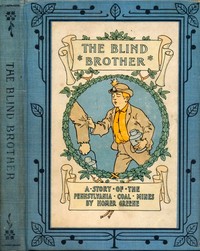
The Blind Brother: A Story of the Pennsylvania Coal Mines — A Closer Reading can be approached with a clearer sense of reading commitment from its source measurements: 31,051 words, 2 hr 16 min estimated reading time, and 9 detected text sections.
The text analysis averages about 20.0 words per sentence, while the detected sections provide another way to judge how the source is divided.
Project Gutenberg metadata also associates the work with “Conduct of life -- Juvenile fiction,” connecting these edition facts with the source record’s subject description.
Explore this collection
These alternatives are selected using recorded categories and estimated reading time.
About 134 minutes
Young Readers Enchanted Adventures
30,815 recorded words. 2 minutes difference from this book's estimate.
View Gutenberg source #46146About 142 minutes
Young Readers Enchanted Adventures
32,461 recorded words. 6 minutes difference from this book's estimate.
View Gutenberg source #50698About 146 minutes
Young Readers Enchanted Adventures
33,397 recorded words. 10 minutes difference from this book's estimate.
View Gutenberg source #52572Search stored excerpts and compare books → Choose by your preferences →
Choices use stored catalog measurements. Estimates vary with reading speed. A shared category is a catalog label, not a claim that two books have the same argument or literary quality.
Search reads excerpt text stored with this catalog and links to its associated Gutenberg record. The connection is stored in the site database; this tool does not recheck that every excerpt is word-for-word identical to that external record. Excerpt search does not cover every chapter and does not verify historical publication dates.
Catalog snapshot checked: 2026-09-25. Coverage: 95 public books, 95 available source excerpts.
Calculated from edition completeness, EPUB availability, text structure and catalogue metadata. Not a user rating.
Total of 100 points, scaled to a 2.5-5.0 range. Editions with an empty description or a missing EPUB file are not scored.
Public-domain source text
The source text is kept in the dedicated reader, separate from this catalogue record and its commentary.
Homer Greene's The Blind Brother opens with a description of the Dryden Mine as a place where 'its headings and airways and chambers echo only to the occasional fall of loosened slate, or to the drip of water from the roof.' This attention to the physical details of the mine—its crumbling pillars and mouldy props—establishes a setting that is both specific and atmospheric. The novel, originally serialized in The Youth's Companion, won a $1,500 prize in 1886, and its language reflects a careful balance between regional authenticity and narrative clarity.
Greene renders the speech of his working-class characters with a phonetic dialect that marks their social position. Tom, the protagonist, speaks in a vernacular that includes contractions like 'an'' for 'and' and phrases such as 'I can’t swear that it was' and 'I was s’prised like.' This choice is not merely decorative; it creates a contrast with the formal language of the lawyers and judge. When Tom testifies, his halting, breathless delivery—'An’ I run, an’ I didn’t look back'—conveys both his fear and his honesty. The author uses this linguistic divide to underscore the tension between the boy's moral simplicity and the legal system's procedural complexity.
The mine is not just a backdrop but a presence that shapes the action. Greene describes it in terms of decay: 'its pillars, robbed by retreating workmen, are crumbling and rusty.' The language of abandonment—'the rats that once scampered through its galleries deserted it'—gives the mine a history of its own. This attention to the physical environment extends to the loading-place and the dark hillside where Tom overhears the arsonist. The setting is rendered with enough specificity to ground the plot, yet it also serves as a source of danger and moral testing.
Greene's dialogue often carries the burden of the novel's ethical concerns. When Tom returns the money given to him, he says, 'Cause I had no right to it, an’ he knows who it belongs to.' This simple statement, stripped of legal jargon, reveals his integrity. The courtroom exchanges are structured to highlight the conflict between truth and legal strategy. The judge's abrupt 'The objection is sustained' and Pleadwell's procedural maneuvers show how the law can obscure justice. Greene uses these exchanges to explore the gap between what is legally permissible and what is morally right.
The novel's eight chapters move from a mine accident to a trial, a fall, and a recovery. Greene builds suspense through careful pacing, as in the trial scene where Tom's testimony is interrupted by objections. The reader learns the full story only gradually, through Tom's reluctant admissions. The author also uses physical details—the 'blaze start up right where he come from'—to create vivid moments of crisis. This structure, typical of serialized fiction, keeps the plot moving while allowing for moments of reflection on the characters' choices.
Readers attentive to Greene's use of dialect and setting will find a story that uses its mining backdrop not just for local color but as a crucible for character. The novel's courtroom scenes reward close reading for how they stage the tension between spoken truth and legal form. The Blind Brother offers a specific, grounded look at how one author handled the demands of prize-winning serial fiction in the late nineteenth century.
There’s a particular ache in The Blind Brother—the way the mine’s dark corridors echo the boy’s own groping moral path. That same quiet pull, the sense of a river guiding someone who can’t quite see ahead, stayed with me long after. It surfaced again, softer yet familiar, while reading The Lure of the Mississippi — A Reader’s Guide, almost as if the water remembered the coal dust.
Save your reaction, strongest insight, and memorable passage.