About 376 minutes
The Third Miss St Quentin — A Closer Reading
Young Readers Enchanted Adventures
86,365 recorded words. 4 minutes difference from this book's estimate.
View Gutenberg source #43109
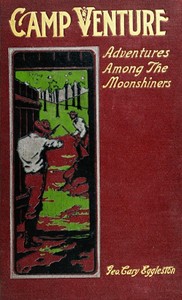
For Camp Venture: A Story of the Virginia Mountains — Context and Discussion, the stored edition analysis reports 85,408 words, 6 hr 12 min estimated reading time, and 8 detected text sections.
The text analysis averages about 19.3 words per sentence, while the detected sections provide another way to judge how the source is divided.
Project Gutenberg metadata also associates the work with “Mountain life -- Juvenile fiction,” connecting these edition facts with the source record’s subject description.
Explore this collection
These alternatives are selected using recorded categories and estimated reading time.
About 376 minutes
Young Readers Enchanted Adventures
86,365 recorded words. 4 minutes difference from this book's estimate.
View Gutenberg source #43109About 376 minutes
Young Readers Enchanted Adventures
86,341 recorded words. 4 minutes difference from this book's estimate.
View Gutenberg source #53868About 381 minutes
Young Readers Enchanted Adventures
87,491 recorded words. 9 minutes difference from this book's estimate.
View Gutenberg source #43169Search stored excerpts and compare books → Choose by your preferences →
Choices use stored catalog measurements. Estimates vary with reading speed. A shared category is a catalog label, not a claim that two books have the same argument or literary quality.
Search reads excerpt text stored with this catalog and links to its associated Gutenberg record. The connection is stored in the site database; this tool does not recheck that every excerpt is word-for-word identical to that external record. Excerpt search does not cover every chapter and does not verify historical publication dates.
Catalog snapshot checked: 2026-09-25. Coverage: 95 public books, 95 available source excerpts.
Calculated from edition completeness, EPUB availability, text structure and catalogue metadata. Not a user rating.
Total of 100 points, scaled to a 2.5-5.0 range. Editions with an empty description or a missing EPUB file are not scored.
Public-domain source text
The source text is kept in the dedicated reader, separate from this catalogue record and its commentary.
From the opening lines, Eggleston establishes a colloquial, bantering tone among the boys. Jack Ridsdale's mock-parliamentary motion to camp—'All in favor say aye. The motion's carried unanimously'—sets a pattern of playful self-governance that runs through the story. The dialogue is brisk and natural, with characters interrupting each other and speaking in clipped, idiomatic phrases. The author rarely lingers on description; instead, he lets action and speech carry the narrative forward. Even the setting is conveyed through practical details: 'grazing for the mules,' 'timber around for fire wood,' and the sound of water trickling from a cliff.
Eggleston's characters speak in a distinctly American vernacular, with a rhythm that suggests oral storytelling. Jack's opening complaint—'I'm tired, and the other pack mules are tired, and from the way you move I imagine that the rest of you donkeys are tired!'—uses repetition and a teasing address to the group. The boys' dialogue is laced with humor and understatement, as when Tom, after killing a bear, remarks on the 'hard' necessity of 'shoot[ing] a friend that had come to our rescue.' The author avoids formal exposition, letting personalities emerge through what they say and how they say it. The Doctor, for instance, speaks with a measured, explanatory tone that contrasts with the boys' impulsive chatter.
The narrative focuses on the how of survival: building a cabin, skinning a bear, cooking over a fire. Eggleston renders these tasks with precise, step-by-step detail. When the boys prepare the bear, Jack fashions a 'gambrel' stick from a bent piece of round wood, sharpening its ends to insert under the tendons. Ed interrupts the skinning to insist on cutting the animal open first for the heart, liver, and kidneys, muttering a recipe for 'bear giblets and beans.' The author's interest lies in the ingenuity of the boys, not in sentimentalizing the wilderness. Even the bear's motivation is explained practically: 'He was hungry, like the rest of us,' Tom says, noting that heavy snow drives bears down to lower regions in search of food.
Eggleston structures the story as a series of episodic challenges, each chapter heading signaling a new development: 'A Picket Shot,' 'The Building of a Cabin,' 'An Armed Negotiation.' The pacing is brisk, with dialogue and action alternating to maintain momentum. The author often ends chapters on a note of suspense or resolution, as when Tom's bear hunt concludes with the animal dragged into the cabin and the boys setting to work. The narrative rarely pauses for reflection; instead, it moves from one practical problem to the next. This structure mirrors the boys' own methodical approach to their venture, where each task—from negotiating with moonshiners to mining coal—is tackled with a blend of humor and determination.
Throughout the excerpts, the boys repeatedly organize themselves through informal votes and collective decisions. Jack's mock-parliamentary language—'I move that we camp here for the night'—is echoed in later chapters like 'A New Declaration of Independence.' This motif of self-governance is paired with a constant emphasis on resourcefulness. The boys improvise tools, repurpose materials, and adapt to setbacks. When Ed suggests saving every ounce of bear fat for cooking, it reflects a mindset of conservation and planning. The author does not romanticize their efforts; instead, he presents them as practical responses to necessity. The bear's hide, Tom notes, will be 'a valuable addition to my collection of pelts,' a line that underscores the boys' systematic approach to their mountain life.
Readers attentive to dialogue will find Eggleston's ear for colloquial speech one of the book's chief pleasures. The boys' voices are distinct, their banter revealing character without authorial commentary. The story rewards those who enjoy watching characters solve problems through ingenuity and teamwork, rather than through dramatic conflict or moralizing. Approach the novel as a series of linked episodes, each centered on a practical challenge, and you will appreciate the author's craft in making survival both vivid and entertaining.
That rainy afternoon, Camp Venture kept me company while the eaves dripped. The boys’ makeshift world—smoke-stained canvas, joking quarrels, the bear’s sudden weight on the trail—felt real enough to touch. Afterwards, I lingered over the idea of travel as a kind of escape. That’s how I found The Motor Boys Overland; Or, A Long Trip for Fun and Fortune — Themes and Context, where the road simply opens ahead, no mountain to climb.
Answer a few questions and save a private reflection on this device.