About 376 minutes
The Third Miss St Quentin — A Closer Reading
Young Readers Enchanted Adventures
86,365 recorded words. 0 minutes difference from this book's estimate.
View Gutenberg source #43109
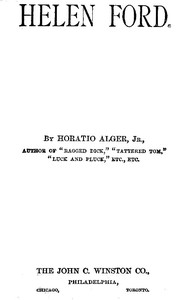
Before opening Helen Ford — Text and Context, the edition data offers a quick orientation: 86,341 words, 6 hr 16 min estimated reading time, and 47 detected text sections.
The text analysis averages about 14.0 words per sentence, while the detected sections provide another way to judge how the source is divided.
Project Gutenberg metadata also associates the work with “Conduct of life -- Juvenile fiction,” connecting these edition facts with the source record’s subject description.
Explore this collection
These alternatives are selected using recorded categories and estimated reading time.
About 376 minutes
Young Readers Enchanted Adventures
86,365 recorded words. 0 minutes difference from this book's estimate.
View Gutenberg source #43109About 372 minutes
Young Readers Enchanted Adventures
85,408 recorded words. 4 minutes difference from this book's estimate.
View Gutenberg source #41919About 381 minutes
Young Readers Enchanted Adventures
87,491 recorded words. 5 minutes difference from this book's estimate.
View Gutenberg source #43169Search stored excerpts and compare books → Choose by your preferences →
Choices use stored catalog measurements. Estimates vary with reading speed. A shared category is a catalog label, not a claim that two books have the same argument or literary quality.
Search reads excerpt text stored with this catalog and links to its associated Gutenberg record. The connection is stored in the site database; this tool does not recheck that every excerpt is word-for-word identical to that external record. Excerpt search does not cover every chapter and does not verify historical publication dates.
Catalog snapshot checked: 2026-09-25. Coverage: 95 public books, 95 available source excerpts.
Calculated from edition completeness, EPUB availability, text structure and catalogue metadata. Not a user rating.
Total of 100 points, scaled to a 2.5-5.0 range. Editions with an empty description or a missing EPUB file are not scored.
Public-domain source text
The source text is kept in the dedicated reader, separate from this catalogue record and its commentary.
The opening chapter situates readers in a large, unfashionable lodging-house near Broadway, where mechanics, clerks, and seamstresses coexist under a roof that enforces its own social hierarchies. Alger immediately establishes that even among the poor, distinctions are jealously maintained—a detail that sets up the novel's preoccupation with class and aspiration. The first excerpt introduces Helen indirectly, through the building's atmosphere and the narrator's wry observation that equality is absent even here.
The novel opens not with its heroine but with a building: a boarding-house on a cross street near Broadway, described as “not especially inviting.” Alger uses this setting to sketch a social ecosystem where mechanics, working-men, clerks on small salaries, seamstresses, and “specimens of decayed gentility” mingle. The narrator notes that social distinctions are more jealously maintained in lower ranks than in higher ones—a claim that primes readers to watch for status anxiety among the characters. The building itself becomes a character, its stairways and thin walls hosting collisions between ambition and necessity.
Early chapters introduce two contrasting figures: a dreamer whose quiet life is shattered when his labor proves futile, and a lawyer named Lewis Rand who achieves a “triumph” by exploiting that collapse. The dreamer’s hopes, we are told, were “realities” to him, and their destruction leaves him alone. Rand’s victory is described as “complete.” These passages, though fragmentary, suggest a pattern of predation: one character’s imaginative world is dismantled by another’s calculating ambition. The novel’s title character, Helen, appears to be caught between such forces.
By Chapter XXIV, Helen has become a successful singer. The manager, Mr. Bowers, summons her to his office and, after dismissing an amateur playwright’s manuscript, offers to double her salary if she signs a contract for the remainder of the season. Helen, who had feared dismissal, is overwhelmed by gratitude. Bowers’s internal monologue reveals his motive: he wants to bind her before a rival theater lures her away. The scene illustrates Alger’s interest in economic vulnerability—Helen’s relief at a raise she did not ask for underscores her precarious position, even in success.
Catalog subjects list forgery and wills among the novel’s concerns, and chapter titles such as “The Blow Falls,” “Reading the Will,” and “Jacob Seals His Fate” point to a legal thriller woven into the domestic narrative. The excerpts do not reveal who forges what, but the presence of a “pettyfogger” (a contemptuous term for a lawyer) in Chapter V and a character named Sharp suggest that legal trickery will drive the conflict. Readers should watch for documents—wills, contracts, letters—as objects that carry the story’s weight.
Two chapter titles—“A Woman’s Heart” and “The Slave of the Needle”—signal Alger’s attention to female labor and emotion. The latter likely refers to seamstresses, a group mentioned in the opening lodging-house description. Helen’s trajectory from potential needleworker to stage performer mirrors a common Alger pattern: a protagonist escapes drudgery through talent and luck. Yet the excerpts show that even onstage, Helen remains subject to managers and contracts. The novel may question how much independence her new profession truly affords.
Readers approaching Helen Ford for the first time will benefit from tracking how Alger uses physical spaces—the lodging-house, the manager’s office, the stage—to map social positions. The excerpts suggest a narrative that oscillates between domestic vulnerability and theatrical success, with legal machinations lurking in the background. Pay attention to the characters who appear in both the early boarding-house scenes and later chapters; their recurrence may reveal the novel’s moral geography.
Reading Helen Ford — Text and Context, I kept thinking of the quiet way sisters maneuver around each other’s ambitions, how forgery and inheritance feel less like plots than family weather. That same unhurried texture—observation over drama—brings me back to Sisters — Context and Discussion, where resemblance isn’t fate, just a gentle starting point.
Your answers remain private and are stored only in this browser.