About 399 minutes
A Little Girl in Old San Francisco — Context and Discussion
Historical Psychological Social Fiction
91,675 recorded words. 13 minutes difference from this book's estimate.
View Gutenberg source #42582
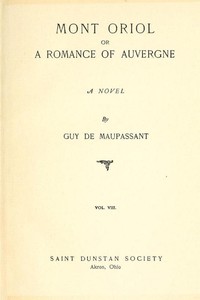
For Mont Oriol; or, A Romance of Auvergne: A Novel — Text and Context, the stored edition analysis reports 94,746 words, 6 hr 52 min estimated reading time, and 8 detected text sections.
The text analysis averages about 19.3 words per sentence, while the detected sections provide another way to judge how the source is divided.
Project Gutenberg metadata also associates the work with “Domestic fiction,” connecting these edition facts with the source record’s subject description.
Explore this collection
These alternatives are selected using recorded categories and estimated reading time.
About 399 minutes
Historical Psychological Social Fiction
91,675 recorded words. 13 minutes difference from this book's estimate.
View Gutenberg source #42582About 391 minutes
Historical Psychological Social Fiction
89,703 recorded words. 21 minutes difference from this book's estimate.
View Gutenberg source #43120About 365 minutes
Historical Psychological Social Fiction
83,833 recorded words. 47 minutes difference from this book's estimate.
View Gutenberg source #47935Search stored excerpts and compare books → Choose by your preferences →
Choices use stored catalog measurements. Estimates vary with reading speed. A shared category is a catalog label, not a claim that two books have the same argument or literary quality.
Search reads excerpt text stored with this catalog and links to its associated Gutenberg record. The connection is stored in the site database; this tool does not recheck that every excerpt is word-for-word identical to that external record. Excerpt search does not cover every chapter and does not verify historical publication dates.
Catalog snapshot checked: 2026-09-25. Coverage: 95 public books, 95 available source excerpts.
Calculated from edition completeness, EPUB availability, text structure and catalogue metadata. Not a user rating.
Total of 100 points, scaled to a 2.5-5.0 range. Editions with an empty description or a missing EPUB file are not scored.
Public-domain source text
The source text is kept in the dedicated reader, separate from this catalogue record and its commentary.
From its opening pages, Mont Oriol establishes a clinical attention to the routines of a fledgling spa. The first bathers walk slowly under huge trees; the woman named Marie sits impassive by the spring, rising only when a patient approaches. Maupassant’s prose is deliberately flat here, cataloguing the nearly empty establishment, the three walks, the straw roof over the cement basin. This measured, almost documentary tone gives way to sharper irony when the financier Andermatt proposes naming the springs after his wife and the Oriol daughters, dismissing the doctors’ vanity with a cool pragmatism. The novel’s voice oscillates between these registers—detached reportage and satirical observation—before tightening into the uncomfortable intimacy of the stomach-washing scene, where the patient Riquier is described as “squeezed and choked up in a kind of straight waistcoat of oilcloth,” a moment that foreshadows the psychological constriction to come.
The Enval spa is not merely a backdrop but a mechanism that drives the plot. Maupassant devotes careful description to the physical layout—the “huge trees,” the stream, the three walks—and to the social hierarchy of doctors, investors, and patients. The naming dispute in Chapter III reveals how medical authority is negotiated through flattery and branding. Andermatt’s argument that naming springs after doctors would “alienate from us forever” their rivals exposes the competitive logic beneath the therapeutic veneer. The prose here is brisk, full of direct speech and strategic pauses, as when Andermatt declares, “I propose to give quite simply the name of my wife to the spring first discovered.” This commercial maneuvering is presented without moral commentary, leaving the reader to gauge the gap between the spa’s promised cures and its actual operations.
Maupassant’s narrative voice becomes most pointed when depicting medical procedures. The scene of Riquier awaiting his stomach washing is rendered with clinical precision: he is “squeezed and choked up in a kind of straight waistcoat of oilcloth,” his expression “wretched, restless, and pained.” Doctor Latonne’s enthusiasm for the “Baraduc probe” is described as an “infantile delight,” undercutting the authority of the medical profession. The prose slows to dwell on the apparatus and the patient’s helplessness, a shift in pace that contrasts with the rapid negotiations of earlier chapters. This attention to physical discomfort recurs throughout the excerpts, suggesting that the body—its ailments, its treatments, its betrayals—is a central concern. The narrative does not endorse or condemn the treatments; it simply observes, with a detachment that borders on the clinical.
The excerpts show a marked variation in narrative tempo. Early chapters move quickly through dialogue and action: Andermatt’s proposal, the doctors’ responses, the hurried arrangements for the fête. Sentences are short, often beginning with “He” or “They,” and the focus is on external events. Later, the pace slows as the narrative enters the minds of characters. The brief glimpse of Paul Bretigny, who “had only arrived the previous evening,” hints at a more introspective register. The stomach-washing scene, though still external, is drawn out with sensory detail—the oilcloth, the wooden armchair—creating a sense of duration. This rhythmic variation suggests that the novel’s psychological depth emerges not from constant interiority but from the contrast between public performance and private ordeal. The reader is left to infer how these shifts mirror the characters’ own tensions.
Readers attentive to narrative voice will find in Mont Oriol a study in tonal modulation. Maupassant moves from the brisk, ironic exchanges of the spa’s promoters to the slow, uncomfortable scrutiny of a patient’s body, and finally to the hinted interiority of characters like Paul. The novel rewards those who watch for these shifts in pace and perspective, as they often signal the moments when the social surface cracks to reveal something more uneasy beneath.
I’ve often shelved Mont Oriol beside a certain quieter companion, its mineral waters and tangled hearts somehow echoing the careful architecture of Three Sides of Paradise Green — Inside the Classic. Both know how a place’s promise can mask a deeper, human fracture. They sit together like old friends, sharing a knowing glance about the cost of beauty.
Build a private reading journal entry for this title.