About 253 minutes
The Train Boy — A Reader’s Guide
Young Readers Enchanted Adventures
58,050 recorded words. 5 minutes difference from this book's estimate.
View Gutenberg source #55725
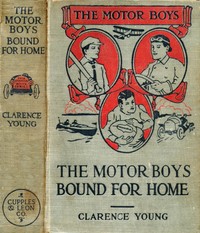
The catalog record for The Motor Boys Bound for Home; or, Ned, Bob and Jerry on the Wrecked Troopship — Edition Insights provides practical reading context through 56,938 words, 4 hr 8 min estimated reading time, and 31 detected text sections.
The text analysis averages about 14.4 words per sentence, while the detected sections provide another way to judge how the source is divided.
Project Gutenberg metadata also associates the work with “World War, 1914-1918 -- Juvenile fiction,” connecting these edition facts with the source record’s subject description.
Explore this collection
These alternatives are selected using recorded categories and estimated reading time.
About 253 minutes
Young Readers Enchanted Adventures
58,050 recorded words. 5 minutes difference from this book's estimate.
View Gutenberg source #55725About 241 minutes
Young Readers Enchanted Adventures
55,272 recorded words. 7 minutes difference from this book's estimate.
View Gutenberg source #41877About 256 minutes
Young Readers Enchanted Adventures
58,730 recorded words. 8 minutes difference from this book's estimate.
View Gutenberg source #40179Search stored excerpts and compare books → Choose by your preferences →
Choices use stored catalog measurements. Estimates vary with reading speed. A shared category is a catalog label, not a claim that two books have the same argument or literary quality.
Search reads excerpt text stored with this catalog and links to its associated Gutenberg record. The connection is stored in the site database; this tool does not recheck that every excerpt is word-for-word identical to that external record. Excerpt search does not cover every chapter and does not verify historical publication dates.
Catalog snapshot checked: 2026-09-25. Coverage: 95 public books, 95 available source excerpts.
Calculated from edition completeness, EPUB availability, text structure and catalogue metadata. Not a user rating.
Total of 100 points, scaled to a 2.5-5.0 range. Editions with an empty description or a missing EPUB file are not scored.
Public-domain source text
The source text is kept in the dedicated reader, separate from this catalogue record and its commentary.
The collision sequence in chapter I establishes the book's central puzzle: a troopship struck in fog by a vessel that backs away without a sound. Ned's insistence that he saw camouflage paint, not an iceberg, sets up a mystery that the officers debate with conflicting theories. The scraped paint on a broken rail becomes physical evidence, grounding the fantastic in a tangible detail.
This opening also introduces a pattern of separation. Ned's immediate concern after the crash is not the damage but the whereabouts of Bob, Jerry, and Professor Snodgrass. The narrative voice shifts between collective confusion and Ned's isolated perspective, a technique that recurs throughout the excerpts.
The collision scene hinges on visual evidence. Ned sees “camouflage paint” on the striking vessel, a detail that an officer dismisses as possibly an iceberg. The argument is resolved by a physical trace: flecks of blue and white paint on a splintered rail. This forensic moment is rare in adventure fiction of the period, giving the mystery a concrete anchor.
The officer's conclusion that the ship must be a derelict raises a logical problem—how can an abandoned vessel back away? The narrative leaves this tension unresolved in the excerpt, inviting readers to question whether the ship is truly unmanned or if something else is at work. The word “derelict” recurs as a label that both explains and deepens the enigma.
The fog itself becomes a character, swallowing the other ship and isolating the Sherman. Sound is conspicuously absent: no whistle, no shouting, only the crash and then silence. This sensory deprivation heightens the unease.
Immediately after the collision, Ned's thoughts turn to his missing friends. The narrative intercuts his physical shock with the realization that Jerry, Bob, and Professor Snodgrass are not where they were moments before. This pattern of separation and reunion is a structural motif in the Motor Boys series, but here it is tied to the chaos of a wartime accident.
The officer's question—“Who else was here with you at the time?”—forces Ned to reconstruct the scene. His memory includes not only his friends but also a sailor from whom the professor was about to remove a bug. This odd detail, the bug-collecting subplot, contrasts with the life-or-death stakes of the collision, creating a tonal shift typical of the series.
Later chapter titles such as “A Waif of the Sea” and “Three on a Raft” confirm that separation drives the plot. The excerpts suggest that the boys are scattered across the ocean, each facing solitary challenges before reuniting.
The book opens with the Sherman leaving Brest, cheered by soldiers who envy those sailing for home after the Great War. This celebratory mood is shattered by the collision, transforming a homecoming into a survival ordeal. The contrast between the expected joy of return and the sudden danger is sharp.
Ned's role as a witness—the only one who saw the other ship clearly—places him in a position of authority but also isolation. He must convince skeptical officers of what he saw. This dynamic echoes the broader theme of perception versus reality in wartime, where fog and camouflage obscure the truth.
The catalog subject “War neuroses” hints at psychological strain, though the excerpts do not develop it explicitly. The collision itself can be read as a metaphor for the unpredictable aftermath of war, where even the journey home carries hidden threats.
Readers approaching this book should attend to the way the narrative balances multiple threads: the mystery of the silent ship, the physical survival of the boys at sea, and the underlying tension of a homecoming that never quite arrives. The excerpts offer only fragments of the full plot, but they reveal a writer skilled at using sensory details—paint flecks, fog, silence—to build suspense. The Motor Boys' resourcefulness is tested not by enemy action but by the sea itself and the enigma of a derelict that behaves like a manned vessel.
Reading about Ned, Bob, and Jerry adrift, their quiet separation amid the fog, I remembered a different kind of isolation underground. That story of the mines, with its shared darkness and unspoken burdens, felt similarly heavy. This The Blind Brother: A Story of the Pennsylvania Coal Mines — A Closer Reading keeps surfacing in my mind, a companion to that lonely feeling of waiting for rescue.
Save your reaction, strongest insight, and memorable passage.