About 326 minutes
Frank Merriwell's Backers; Or, The Pride of His Friends — Context and Discussion
Young Readers Enchanted Adventures
74,870 recorded words. 1 minutes difference from this book's estimate.
View Gutenberg source #39433
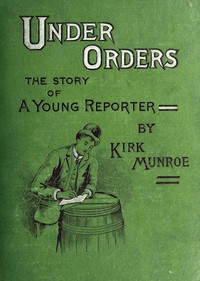
Before opening Under Orders: The story of a young reporter — Key Ideas to Explore, the edition data offers a quick orientation: 75,078 words, 5 hr 27 min estimated reading time, and 28 detected text sections.
The text analysis averages about 18.6 words per sentence, while the detected sections provide another way to judge how the source is divided.
Project Gutenberg metadata also associates the work with “Poor -- Juvenile fiction,” connecting these edition facts with the source record’s subject description.
Explore this collection
These alternatives are selected using recorded categories and estimated reading time.
About 326 minutes
Young Readers Enchanted Adventures
74,870 recorded words. 1 minutes difference from this book's estimate.
View Gutenberg source #39433About 331 minutes
Young Readers Enchanted Adventures
75,998 recorded words. 4 minutes difference from this book's estimate.
View Gutenberg source #42840About 335 minutes
Young Readers Enchanted Adventures
76,886 recorded words. 8 minutes difference from this book's estimate.
View Gutenberg source #42014Search stored excerpts and compare books → Choose by your preferences →
Choices use stored catalog measurements. Estimates vary with reading speed. A shared category is a catalog label, not a claim that two books have the same argument or literary quality.
Search reads excerpt text stored with this catalog and links to its associated Gutenberg record. The connection is stored in the site database; this tool does not recheck that every excerpt is word-for-word identical to that external record. Excerpt search does not cover every chapter and does not verify historical publication dates.
Catalog snapshot checked: 2026-09-25. Coverage: 95 public books, 95 available source excerpts.
Calculated from edition completeness, EPUB availability, text structure and catalogue metadata. Not a user rating.
Total of 100 points, scaled to a 2.5-5.0 range. Editions with an empty description or a missing EPUB file are not scored.
Public-domain source text
The source text is kept in the dedicated reader, separate from this catalogue record and its commentary.
Kirk Munroe's Under Orders (1890) opens with a question that sets the tone for its young protagonist's entry into journalism: "ANY THING GOING ON TO-NIGHT?" The novel's dialogue is brisk and functional, often carrying plot information or character judgment. Munroe's descriptive passages favor concrete details—a missing steel pin, a fifty-dollar bill arriving by mail—over emotional interiority. The story's setting moves from New York City streets to a strike-bound railway, and the author's choice to dedicate the book to city editor John Bogart signals a respect for the practical ethics of newspaper work.
Munroe's prose is lean and action-oriented, with sentences that often begin with a character's immediate perception: "Myles soon learned that the difficulty was with the locomotive." The vocabulary reflects a late-nineteenth-century urban milieu—words like "dispatch," "round-house," and "spotter" appear without explanation, assuming reader familiarity. Dialogue is terse and directive: "I'll thank you, sir, for my watch, together with a receipted bill for my board to date." This efficiency mirrors the newspaper world's demand for speed. Munroe also uses repetition for emphasis, as when the missing "small steel pin" is mentioned three times in quick succession, underscoring the mechanical obstacle that drives the plot.
Myles Manning's voice is earnest and slightly formal, marked by phrases like "you may depend upon it" and "I don't see how I can very well refuse to take it." Munroe distinguishes characters through speech patterns: the landlord replies "without a word," while the anonymous benefactor writes in a polished, indirect style ("Having accidentally learned of your temporary embarrassment"). The narrator occasionally adopts a knowing tone, as in "the same important little pin was missing from every one of them," which hints at sabotage. This narrative voice aligns with the protagonist's perspective, filtering events through Myles's growing understanding of the world.
Munroe structures chapters around incremental revelations. In the excerpt, a letter arrives with a postmark bearing "the date of that very day," creating a coincidence that feels engineered for dramatic effect. The pacing alternates between tense action (the disabled locomotive) and reflective pauses (Myles reading the letter in his room). Chapter titles like "The Strikers Capture a Train" promise action, but Munroe delays the payoff with detailed explanations of mechanical failures. This rhythm—crisis, explanation, resolution—mirrors the reporting process itself: gathering facts before delivering the story. The author also uses physical objects (the watch, the bill) as narrative anchors that connect scenes.
The setting is rendered through functional, not decorative, description. A hotel room is defined by its "mantel shelf that nearly filled one side of the room"; a railway station is a place of "small groups" and waiting. Munroe focuses on what characters see and use: the locomotive's "great wheels," the "connecting rod" that falls, the "small steel pin." These details ground the story in a tangible world of machinery and money. The urban setting of New York is evoked through references to street life and newspaper offices, but the strike sequence shifts to a more industrial landscape. Munroe's descriptions serve the plot rather than atmosphere, emphasizing obstacles and tools over scenery.
Readers attentive to Munroe's craft will notice how he uses dialogue to convey social hierarchy—the landlord's silence, the benefactor's anonymity—and how physical details (a missing pin, a fifty-dollar bill) function as plot engines. The novel's dedication to a real city editor suggests that Munroe valued accuracy in depicting journalistic work. Approach Under Orders as a period artifact that rewards attention to its specific, unadorned language and its portrayal of a young man learning to operate under orders.
Reading Munroe’s Myles Manning, I kept thinking of the gentler pace in Annie Laurie and Azalea — A Reader’s Guide. Both carry that old-fashioned belief that steady character matters more than circumstance. His train chase felt loud, but my mind drifted to quieter gardens and patient friendships. Odd, how different worlds can echo the same honest heart.
Build a private reading journal entry for this title.